
Beyond the Hype: AI for Influencer Marketing
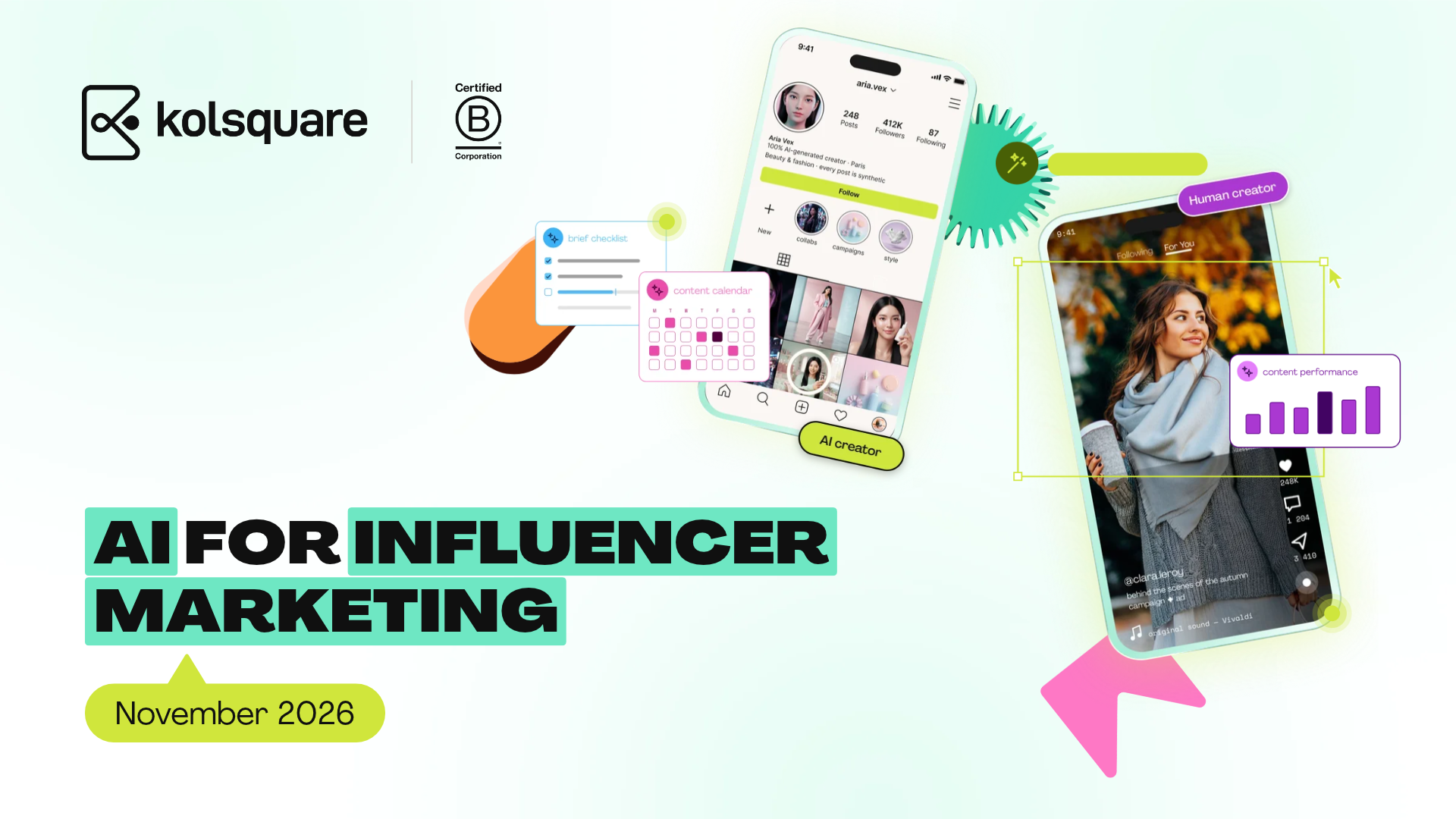
For creators with at least 30% of their audience in the US, AI-tagged organic posts drew 6.8% lower engagement than their other posts. This report shows where AI saves time in campaign work, why American shoppers still trust people over synthetic content and how AI assistants choose which creator reviews to cite. Data: Kolsquare analysis of 87,362 AI-tagged posts from 20,105 creators worldwide.
Table of Contents
What’s Inside
Introduction: After the Hype
Key Takeaways
1. The Gains Are in the Workflow
Case Study: BeInfluence Puts Kolsquare’s MCP and API to Work
2. Trust, Humanity and Creativity: What AI Can’t Fake
Breakout: How Do AI-Tagged Posts Perform?
3. Is the Next Audience an AI Model?
Conclusion: Still a Creator’s Business
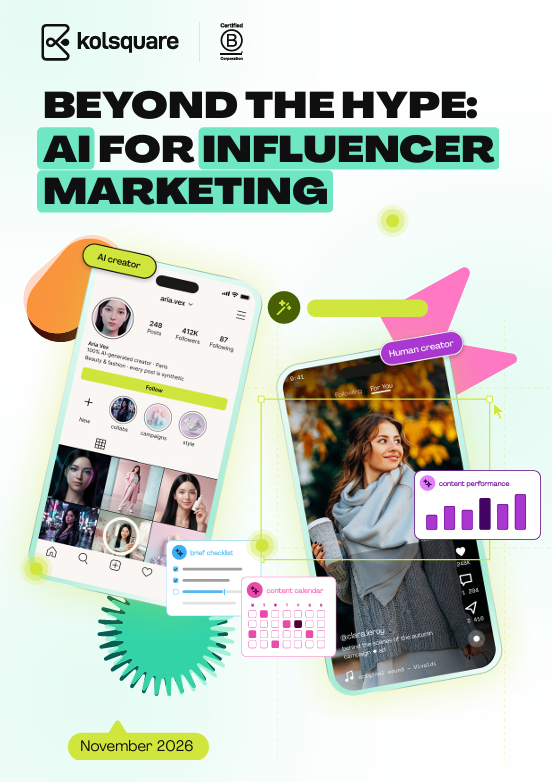
What AI is changing for US brands and agencies: faster campaign workflows, warier audiences and a new kind of search that quotes creators.
Introduction: After the Hype
Is AI Delivering for Marketing Teams Yet?
For most, not yet. In a Bain survey of senior marketing and finance executives, 95% said their organization uses AI tools. Only 6% said those tools deliver substantial results.
The executives who did see returns ran their AI strategy from the center, broke down silos between teams and rebuilt workflows around the tools. Forrester warns that CMOs who cut up to 25% of marketing roles in anticipation of AI gains may be forced to scale back programs in 2027.
“There’s a lot of AI washing in our industry, but underneath it, this is a real revolution,” says Kolsquare founder and CEO Quentin Bordage.
Chapter 1: The Gains Are in the Workflow
Where Does AI Actually Save Time for Influencer Teams?
Adoption is already broad. Of the 1,123 marketing decision-makers in Kolsquare’s The Future of Influencer Marketing: The 2026/2027 Outlook, 84% use AI or automation tools. The most common jobs are audience and content analysis, fraud detection, and campaign planning and briefing, followed closely by influencer discovery.
Picking creators is where teams need to be careful. Agency BeInfluence asked AI to choose 10 creators for a campaign and had its own team choose 10 more. The AI went for two big accounts to hit the reach target. The team’s smaller creators matched that reach, found new audiences and drove more engagement.
“We meet them, and we cast them on a personality, a way of speaking, a state of mind. The numbers follow,” says Cyril Attias, CEO of influencer marketing agency Globe ADMS.
From Reach to Revenue
Brands no longer stop at how many people saw a post. They want store traffic, add-to-cart and sales. Connectors such as Kolsquare’s Model Context Protocol (MCP) server now link creator data with paid media, PR and sales data, so influencer results sit next to the numbers the rest of the business already tracks.
What Has to Be in Place First?
An AI fed mislabeled campaigns and creator names spelled three different ways will answer with confidence and get it wrong. The report sets out three steps, in this order:
- Clean data and a tech stack that talks to itself. Agree on naming first, then pick tools that can share data with each other.
- Training for you and your team. Connected tools pay off only with a defined workflow and a clear job for the AI.
- Agents and automation last. Once the data and the people are ready, connectors can take over routine steps from outreach to reporting.
“It’s very important to see the difference between accessing AI tools and actually having a fully integrated AI workflow,” says Josefine Gustafson, Director of Operations at Swedish agency We Are Era.
Chapter 2: Trust, Humanity and Creativity
How Do AI-Tagged Posts Perform With US Audiences?
Worse, on organic content. Kolsquare compared each creator’s AI-tagged posts with their other posts on Instagram and TikTok from October 2025 to September 2026. Creators with at least 30% of their audience in the US saw AI-tagged organic posts draw 6.8% lower engagement and 1.8% lower earned media value (EMV). On sponsored posts, the difference was too small to call.
The worldwide picture points the same way, with most of the gap coming from TikTok.
| Post type | Market | Creators compared | AI-tagged posts | Engagement rate change | EMV change | Result |
|---|---|---|---|---|---|---|
| Organic | US | 4,623 | 23,488 | -6.8% | -1.8% | Lower engagement rate and EMV |
| Organic | Europe | 3,370 | 11,679 | -6.2% | -2.6% | Lower engagement rate and EMV |
| Organic | Worldwide | 20,105 | 87,362 | -5.5% | -1.4% | Lower engagement rate and EMV |
| Sponsored | US | 186 | 402 | -9.5% | +2.7% | No clear difference |
| Sponsored | Europe | 192 | 499 | +2.2% | +4.9% | No clear difference |
| Sponsored | Worldwide | 1,052 | 2,359 | -3.1% | -0.1% | No clear difference |
AI-tagged posts compared with the same creator’s other posts of the same type, by market, October 1, 2025, to September 30, 2026. US and Europe cover creators with at least 30% of their audience in the US, or in Germany, the UK, France, Spain or Italy. Change is the median across creators. “Lower” means statistically significant (sign test, p < 0.05). Source: Kolsquare.
Audiences are already suspicious. More than half of consumers say they can’t reliably spot AI-generated content, and 78% would rather see ads made by people (DoubleVerify and Canva, as cited in the report). Most consumers (68%) don’t object to AI in ads that are helpful or relevant.
What Are the Rules for AI Content in the US?
There is no federal rule yet, but states are moving. Since June, New York has required ads that use AI-generated “synthetic performers” to say so. Brands that also run campaigns in Europe face a stricter regime: since August 2026, the EU AI Act has required anyone using AI professionally to create a deepfake to disclose it, and the European Commission’s non-binding guidelines count a realistic synthetic influencer promoting a real product as one.
“Unflagged synthetic content could destroy a community’s trust,” says Attias. “We’ve seen a few influencers caught out for using AI without saying so.”
Chapter 3: Is the Next Audience an AI Model?
Where Do AI Assistants Fit in the US Shopping Journey?
At the comparison stage. In a June survey by EMARKETER and Viral Nation, TikTok was where most US consumers first saw a product (56.5%), Google Search led for comparing options (48.6%) and AI assistants came close behind (41.5%). Just 13% said they first discovered a product through generative engine optimization (GEO) search.
| Stage | What US consumers did | Share |
|---|---|---|
| Discover | First saw the product on TikTok | 56.5% |
| Compare | Compared options on Google Search | 48.6% |
| Compare | Compared options with an AI assistant | 41.5% |
| Buy | Found a product through social media, a creator or an AI tool and bought it in the past three months | 50.1% |
| Community | Say an online community discussion has influenced a purchase | 59.8% |
The US shopping journey, from first sight to purchase. Source: EMARKETER and Viral Nation, June survey, as cited in the report.
Which Creator Videos Get Cited?
The detailed ones. According to creative intelligence firm Sundogs, 60% of the YouTube videos AI cited in US consumer goods and automotive came from creators. When Sundogs compared 400 cited videos with 3,500 uncited videos by the same creators, the cited ones were far more likely to include a review or demo (77%), set up a clear problem (76%) or compare rival brands (71%). Most ran eight minutes or more, and view counts made no difference.
The market is already moving: 41% of omnichannel retail brands surveyed by Northwestern and LTK use creators for AI-driven search.
“They need to be able to say, this shampoo is better for dry scalp than this one,” Sundogs CEO Ben Jones wrote of the freedom brands should give creators.
Conclusion: Still a Creator’s Business
Does AI Make Creators Less Important?
The evidence points the other way. AI is making campaigns faster and easier to measure, provided the data work is done first. It is flooding feeds with synthetic content, which makes a real person with a loyal community worth more. And it is creating a second audience for creator content, one that rewards detailed, honest reviews.

On this page
Download the full report
The full PDF adds the complete BeInfluence case study, the US shopping-journey chart and a four-point checklist to run before you connect an MCP.
Get the PDFWhat's inside the report
What does the report cover?
- The gains are in the workflow. What AI already does well for influencer teams, the groundwork it needs and how BeInfluence flipped its data split.
- Trust, humanity and creativity: what AI can’t fake. How AI-tagged posts perform with US and European audiences, and where US and EU rules stand.
- Is the next audience an AI model? Where AI assistants sit in the US shopping journey and which creator videos they quote.
In short, and why the full report is worth downloading
What Should US Marketers Take Away?
Four findings, and how Kolsquare helps with each.
AI Is Everywhere, but Only 6% of Executives See Substantial Results
In a Bain survey, 95% of senior marketing and finance executives said their organization uses AI tools. Just 6% said those tools deliver substantial results. The teams pulling ahead redesigned their workflows before adding more tools.
How Kolsquare helps Kolsquare’s MCP lets your team ask campaign and creator questions in plain language from an AI assistant. Explore the MCP →
AI-Tagged Posts Lose 6.8% of Engagement With US Audiences
For creators with at least 30% of their audience in the US, AI-tagged organic posts drew 6.8% lower engagement than their other organic posts, across 4,623 creators and 23,488 posts (Kolsquare, October 2025 to September 2026). Worldwide, the gap reached 21.2% on TikTok.
How Kolsquare helps Influencer Reporting tracks content and performance from every creator across your campaigns. See campaign reporting →
AI Assistants Are Now a Top Product Comparison Tool
Some 41.5% of US consumers compare products with AI assistants, close behind Google Search at 48.6% (EMARKETER and Viral Nation). AI matters less at first discovery: only 13% first meet a product through AI search.
How Kolsquare helps Influencer Discovery searches across creators, content and brands, so you can find the reviewers who cover your category in depth. Find the right creators →
Creators Make 60% of the YouTube Videos AI Cites in Key US Categories
In US consumer goods and automotive, 60% of the YouTube videos cited by AI came from creators (Sundogs). Across all sources, earned media made up 84% of the links cited by the large language models (LLMs) behind ChatGPT, Claude and Gemini, against 0.3% for paid content (Muck Rack).
How Kolsquare helps Influencer CRM keeps creators, campaigns and conversations in one shared workspace, so long-term partnerships stay on track. See campaign management →
6.8% lower engagement on AI-tagged organic posts by creators with US audiences, across 4,623 creators and 23,488 posts. Source: Kolsquare.
41.5% of US consumers compare products using AI assistants, close behind Google Search at 48.6%. Source: EMARKETER and Viral Nation.
89% of brands and agencies plan to raise their influencer spend in the next 12 months, up from 75% a year earlier. Source: Kolsquare.
41% of omnichannel retail brands already use creators for AI-driven search. Source: Northwestern and LTK.
Introduction: After the Hype
Is AI Delivering for Marketing Teams Yet?
For most, not yet. In a Bain survey of senior marketing and finance executives, 95% said their organization uses AI tools. Only 6% said those tools deliver substantial results.
The executives who did see returns ran their AI strategy from the center, broke down silos between teams and rebuilt workflows around the tools. Forrester warns that CMOs who cut up to 25% of marketing roles in anticipation of AI gains may be forced to scale back programs in 2027.
“There’s a lot of AI washing in our industry, but underneath it, this is a real revolution,” says Kolsquare founder and CEO Quentin Bordage.
Chapter 1: The Gains Are in the Workflow
Where Does AI Actually Save Time for Influencer Teams?
Adoption is already broad. Of the 1,123 marketing decision-makers in Kolsquare’s The Future of Influencer Marketing: The 2026/2027 Outlook, 84% use AI or automation tools. The most common jobs are audience and content analysis, fraud detection, and campaign planning and briefing, followed closely by influencer discovery.
Picking creators is where teams need to be careful. Agency BeInfluence asked AI to choose 10 creators for a campaign and had its own team choose 10 more. The AI went for two big accounts to hit the reach target. The team’s smaller creators matched that reach, found new audiences and drove more engagement.
“We meet them, and we cast them on a personality, a way of speaking, a state of mind. The numbers follow,” says Cyril Attias, CEO of influencer marketing agency Globe ADMS.
From Reach to Revenue
Brands no longer stop at how many people saw a post. They want store traffic, add-to-cart and sales. Connectors such as Kolsquare’s Model Context Protocol (MCP) server now link creator data with paid media, PR and sales data, so influencer results sit next to the numbers the rest of the business already tracks.
What Has to Be in Place First?
An AI fed mislabeled campaigns and creator names spelled three different ways will answer with confidence and get it wrong. The report sets out three steps, in this order:
- Clean data and a tech stack that talks to itself. Agree on naming first, then pick tools that can share data with each other.
- Training for you and your team. Connected tools pay off only with a defined workflow and a clear job for the AI.
- Agents and automation last. Once the data and the people are ready, connectors can take over routine steps from outreach to reporting.
“It’s very important to see the difference between accessing AI tools and actually having a fully integrated AI workflow,” says Josefine Gustafson, Director of Operations at Swedish agency We Are Era.
Chapter 2: Trust, Humanity and Creativity
How Do AI-Tagged Posts Perform With US Audiences?
Worse, on organic content. Kolsquare compared each creator’s AI-tagged posts with their other posts on Instagram and TikTok from October 2025 to September 2026. Creators with at least 30% of their audience in the US saw AI-tagged organic posts draw 6.8% lower engagement and 1.8% lower earned media value (EMV). On sponsored posts, the difference was too small to call.
The worldwide picture points the same way, with most of the gap coming from TikTok.
| Post type | Market | Creators compared | AI-tagged posts | Engagement rate change | EMV change | Result |
|---|---|---|---|---|---|---|
| Organic | US | 4,623 | 23,488 | -6.8% | -1.8% | Lower engagement rate and EMV |
| Organic | Europe | 3,370 | 11,679 | -6.2% | -2.6% | Lower engagement rate and EMV |
| Organic | Worldwide | 20,105 | 87,362 | -5.5% | -1.4% | Lower engagement rate and EMV |
| Sponsored | US | 186 | 402 | -9.5% | +2.7% | No clear difference |
| Sponsored | Europe | 192 | 499 | +2.2% | +4.9% | No clear difference |
| Sponsored | Worldwide | 1,052 | 2,359 | -3.1% | -0.1% | No clear difference |
AI-tagged posts compared with the same creator’s other posts of the same type, by market, October 1, 2025, to September 30, 2026. US and Europe cover creators with at least 30% of their audience in the US, or in Germany, the UK, France, Spain or Italy. Change is the median across creators. “Lower” means statistically significant (sign test, p < 0.05). Source: Kolsquare.
Audiences are already suspicious. More than half of consumers say they can’t reliably spot AI-generated content, and 78% would rather see ads made by people (DoubleVerify and Canva, as cited in the report). Most consumers (68%) don’t object to AI in ads that are helpful or relevant.
What Are the Rules for AI Content in the US?
There is no federal rule yet, but states are moving. Since June, New York has required ads that use AI-generated “synthetic performers” to say so. Brands that also run campaigns in Europe face a stricter regime: since August 2026, the EU AI Act has required anyone using AI professionally to create a deepfake to disclose it, and the European Commission’s non-binding guidelines count a realistic synthetic influencer promoting a real product as one.
“Unflagged synthetic content could destroy a community’s trust,” says Attias. “We’ve seen a few influencers caught out for using AI without saying so.”
Chapter 3: Is the Next Audience an AI Model?
Where Do AI Assistants Fit in the US Shopping Journey?
At the comparison stage. In a June survey by EMARKETER and Viral Nation, TikTok was where most US consumers first saw a product (56.5%), Google Search led for comparing options (48.6%) and AI assistants came close behind (41.5%). Just 13% said they first discovered a product through generative engine optimization (GEO) search.
| Stage | What US consumers did | Share |
|---|---|---|
| Discover | First saw the product on TikTok | 56.5% |
| Compare | Compared options on Google Search | 48.6% |
| Compare | Compared options with an AI assistant | 41.5% |
| Buy | Found a product through social media, a creator or an AI tool and bought it in the past three months | 50.1% |
| Community | Say an online community discussion has influenced a purchase | 59.8% |
The US shopping journey, from first sight to purchase. Source: EMARKETER and Viral Nation, June survey, as cited in the report.
Which Creator Videos Get Cited?
The detailed ones. According to creative intelligence firm Sundogs, 60% of the YouTube videos AI cited in US consumer goods and automotive came from creators. When Sundogs compared 400 cited videos with 3,500 uncited videos by the same creators, the cited ones were far more likely to include a review or demo (77%), set up a clear problem (76%) or compare rival brands (71%). Most ran eight minutes or more, and view counts made no difference.
The market is already moving: 41% of omnichannel retail brands surveyed by Northwestern and LTK use creators for AI-driven search.
“They need to be able to say, this shampoo is better for dry scalp than this one,” Sundogs CEO Ben Jones wrote of the freedom brands should give creators.
Conclusion: Still a Creator’s Business
Does AI Make Creators Less Important?
The evidence points the other way. AI is making campaigns faster and easier to measure, provided the data work is done first. It is flooding feeds with synthetic content, which makes a real person with a loyal community worth more. And it is creating a second audience for creator content, one that rewards detailed, honest reviews.
Case Study: BeInfluence
How Did BeInfluence Flip Its 90/10 Data Split?
The agency used to spend 90% of its analysis time pulling data and 10% thinking about it. After connecting Kolsquare’s application programming interface (API) and MCP, data pulling dropped to 30% of that time.
Under 1 minute per campaign question, asked in plain language through the MCP. Source: BeInfluence case study in the report.
Each tool has its own job. The API feeds Kolsquare data into the agency’s own database for dashboards and cross-campaign benchmarks. The MCP plugs Kolsquare into an AI assistant, so an account manager can answer a client mid-call with last week’s results.
Recommendations
What Should US Brands Do Next?
AI is turning into a second audience for creator content, alongside people. The report suggests six moves.
- Ask for specifics in the brief. Give creators room to demonstrate, compare and say who a product is not for.
- Weigh depth, not just reach. Specialists with deep, searchable libraries may count for more in AI answers than their follower numbers suggest.
- Give each platform a job. TikTok and Instagram drive discovery. Long-form YouTube is AI’s top social source.
- Price content for a longer life. A review AI keeps quoting for years outlasts the campaign, which raises usage-rights questions most contracts don’t cover yet.
- Measure before you rebuild. Set a GEO baseline now and move budget as the evidence comes in.
- Split the cost. Long-form reviews and comparison content that LLMs favor could also draw on the GEO budget.
How Kolsquare helps
Put the Findings to Work on Your Own Campaigns
Kolsquare brings creator data, campaign reporting and AI assistants into one place, so US teams can check these findings against their own results.

“Now it’s 30% extracting the data and 70% asking questions.”
Bruno Durbecq, Data & Insights, BeInfluence
How Mature Is Your Influencer Program?
Get a score and two priority actions in three minutes with Kolsquare’s free maturity assessment.
Free tools and a demo
Methodology
How was this report produced?
Beyond the Hype: AI for Influencer Marketing draws on two Kolsquare surveys, Kolsquare platform data, published third-party research and interviews with agency practitioners. The report has no research partner, so every third-party figure is named with its source.
- Authors Sophie Douez, journalist, Kolsquare, and Lucie Torres, SEO & Content Manager, Kolsquare.
- Published November 17, 2026.
- Surveys The Future of Influencer Marketing: The 2026/2027 Outlook surveyed 1,123 marketing decision-makers at brands and agencies in seven European markets, with fieldwork by B2B International in May and June 2026. Voices of the Creator Economy 2025 surveyed 783 verified creators in six European markets, with fieldwork by Kolsquare and NewtonX in May and June 2025.
- Kolsquare platform data Instagram and TikTok posts from October 1, 2025, to September 30, 2026, tagged with hashtags such as #aigenerated or #madewithai, compared with each creator’s own non-AI posts of the same type. Change is the median across creators. The US group covers creators with at least 30% of their audience in the US. Disclosure analysis: 742,000 posts in five European markets.
- Sources Bain, Forrester, McKinsey, DoubleVerify, Canva, EMARKETER and Viral Nation, Northwestern and LTK, Muck Rack, Sundogs, Goodie and IAB UK, plus interviews with BeInfluence, We Are Era and Globe ADMS.
- Limits Only AI content disclosed with a hashtag can be identified. Most differences on sponsored posts were too small to tell apart from chance. The report does not give sample sizes for most third-party studies.
Only in the PDF
What does the full PDF add?
This page covers the headline data. The PDF goes further.
- The AI-tagged post results by network, with Instagram and TikTok side by side.
- The full BeInfluence case study: four tasks before and after, and four places the tools pay off.
- A four-point checklist to run before you connect an MCP.
- Seven key takeaways, each with an action to take.
- Charts on the US shopping journey and on the social sources AI cites most.
Download the full report
Fill in the form at the top of the page to get the PDF.
FAQ
Don't miss a thing!
Every month we gather the top data, trends, and analysis on the creator economy. Only what matters. Straight to your inbox.

New York, NY, 10036-2714
United States