
Beyond the Hype: AI for Influencer Marketing
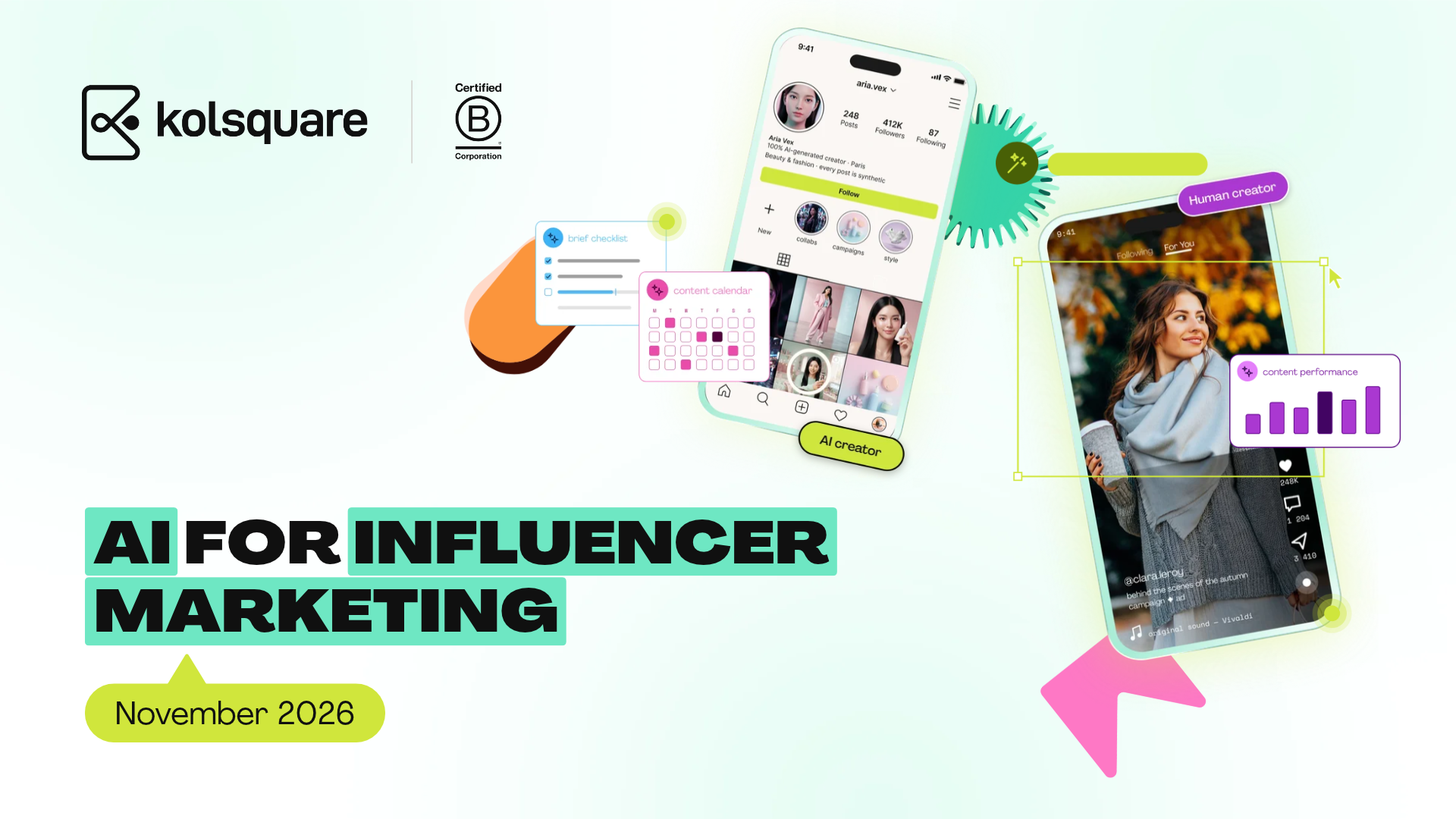
Creators' AI-tagged organic posts draw 5.5% lower engagement than their other posts, and 21.2% lower on TikTok. The report shows where AI saves time in campaign workflows, why human trust still pays and how AI search rewards detailed creator reviews. Data: Kolsquare analysis of 87,362 AI-tagged posts by 20,105 creators.
Table of contents
Inside the report
Introduction: After the hype
Key takeaways
1. The gains are in the workflow
Case study: BeInfluence puts Kolsquare's MCP and API to work
2. Trust, humanity and creativity: what AI can't fake
Breakout: How do AI-tagged posts perform?
3. Is the next audience an AI model?
Conclusion: Still a creator's business
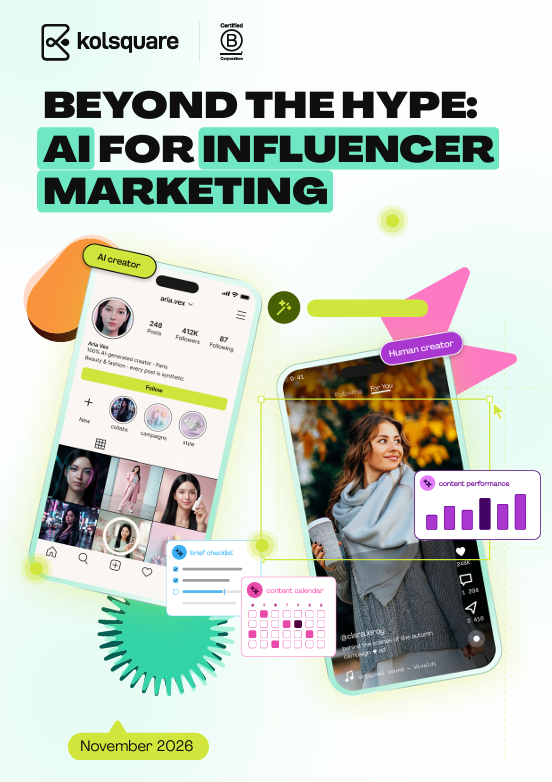
What AI is really changing for influencer marketers: the workflow, audience trust and how AI search picks creators.
Introduction, after the hype
Is AI paying off for marketers yet?
Not yet for most: 89% of brands and agencies expect to raise their influencer spend over the next 12 months, up from 75% a year ago, according to Kolsquare's research, but only 6% of the senior marketing and finance executives surveyed by Bain say AI is delivering substantial results.
In the same Bain survey, 95% said their organisation uses AI tools. The leaders centralised their AI strategy, broke down silos between teams and rebuilt workflows around the tools.
"There's a lot of AI washing in our industry, but underneath it, this is a real revolution," says Quentin Bordage, founder and CEO of Kolsquare.
Chapter 1, the gains are in the workflow
Where does AI help influencer marketing teams?
84% of the 1,123 marketing decision-makers surveyed already use AI or automation tools (Kolsquare, The Future of Influencer Marketing: The 2026/2027 Outlook, fieldwork by B2B International), as do 72% of the 783 creators surveyed (Kolsquare and NewtonX, Voices of the Creator Economy 2025).
Influencer marketers use AI most for audience and content analysis and fraud detection, and for campaign planning and briefing, with influencer discovery close behind.
Reach and engagement scores can't tell whether a creator lives the subject or how strong their community ties are. Agency BeInfluence pitted 10 AI-picked creators against 10 chosen by its team. The AI selected two large accounts to hit the reach goal. The team's smaller creators matched that reach, found different audiences and drove more engagement.
"We meet them, and we cast them on a personality, a way of speaking, a state of mind. The numbers follow," says Cyril Attias, CEO of influencer marketing agency Globe ADMS.
From campaign metrics to business impact
For most brands, creator data still lives in its own tools, while sales, paid media and PR sit elsewhere. AI agents and connectors such as Kolsquare's MCP now connect these data sources, so brands can track store traffic, add-to-cart and sales.
Which foundations come first?
Fed messy data, an AI will answer confidently and wrongly. The report sets out three steps, in order.
- Get the right tools and tech stack. Start with clean, consistent data, then choose tools that can share it with each other.
- Train yourself and your team. Getting value from connected tools takes training, a defined workflow and a clear idea of what the AI is for.
- Connect your marketing tools with agents and automation. This comes last, once the data and the team are ready.
"It's very important to see the difference between accessing AI tools and actually having a fully integrated AI workflow," says Josefine Gustafson, Director of Operations at Swedish agency We Are Era.
Chapter 2, trust, humanity and creativity
Do AI-generated posts perform worse?
A typical creator's AI-tagged organic posts drew 5.5% lower engagement than their other organic posts, according to Kolsquare's comparison of Instagram and TikTok posts from October 2025 to September 2026.
Most of that gap comes from TikTok, where AI-tagged organic posts trailed by about a fifth. The US and Europe follow the same pattern, with AI-tagged organic posts drawing 6.8% and 6.2% lower engagement respectively. Across sponsored posts, the difference was too small to tell apart from chance.
Audiences struggle to tell what is real. More than half of consumers say they can't consistently identify AI-generated content, 42% say low-quality or "uncanny" AI advertising would hurt their opinion of a brand, and 78% would rather see ads made by people, although 68% don't mind AI in ads that are helpful or relevant (DoubleVerify and Canva, as cited in the report).
Disclosure does not cost engagement. Across five European markets, properly disclosed sponsored Instagram posts by creators with 5,000 to 50,000 followers drew a median engagement rate of 1.86%, against 1.61% for posts that fell short of disclosure rules, according to Kolsquare's analysis of 742,000 posts.
What do the rules say about virtual creators?
Since August 2026, the EU AI Act has required deployers who use AI for professional purposes to create a deepfake to disclose that it is artificially generated or manipulated. The Commission's non-binding guidelines treat a realistic synthetic influencer promoting a real product as a deepfake.
The UK has no specific legal requirement to label AI-generated content, though misleading AI content in ads falls under existing advertising and consumer law. In the US, New York has required ads using AI-generated "synthetic performers" to say so since June.
"AI shouldn't take a creator's place, and we won't build tools that promote virtual influencers," says Quentin Bordage of Kolsquare.
Chapter 3, is the next audience an AI model?
How does AI search change the role of creator content?
41.5% of US consumers compare products with AI assistants, close behind Google Search at 48.6%, according to a June survey by EMARKETER and Viral Nation.
Brands now have a new kind of search to optimise for, known as generative engine optimisation (GEO) or answer engine optimisation (AEO). AI's influence comes when people compare options. In Europe, McKinsey found that 38% of consumers in France, Germany and the UK use AI to research products or make purchase decisions, and 63% of them use it to compare brands, prices and reviews.
Which creator content do AI models cite?
AI answers are built mostly from what others say about a brand. Between August and December 2025, YouTube's share of social citations rose from 18.9% to 39.2% while Reddit's fell from 44.2% to 20.3%, according to AI visibility platform Goodie. Instagram took 1.7% and TikTok 0.5%.
Sundogs compared 400 AI-cited videos with 3,500 uncited videos by the same creators. The cited ones were far more likely to feature a review or demonstration (77%), set up a clear problem (76%) or compare rival brands (71%), and usually ran eight minutes or more. Views made no difference.
IAB UK Chief Strategy Officer James Chandler cautions that "showing up in an AI answer isn't the same as causing a recommendation."
Conclusion, still a creator's business
Will AI replace creators?
No: AI is changing influencer marketing in three ways, and none of them leads to a market without creators.
Campaigns are getting faster and better measured, a real person with a loyal community is worth more as feeds fill with synthetic content, and creator content now has a second audience in AI, which rewards detailed, honest reviews.

On this page
Download the full report
The PDF adds the market breakdown of AI-tagged posts, the full BeInfluence case study and the pre-MCP checklist.
Get the PDFWhat's inside the report
What does the report cover?
- The gains are in the workflow. Where AI helps teams today, the foundations it needs and the BeInfluence case study.
- Trust, humanity and creativity: what AI can't fake. Wary audiences, Kolsquare data on AI-tagged posts and the rules on virtual creators.
- Is the next audience an AI model? How AI search changes the shopping journey and which creator content AI models cite.
In short, and why the full report is worth downloading
What are the four findings that matter?
Four findings, and how Kolsquare helps with each.
84% of influencer marketers use AI, but only 6% of executives see substantial results
84% of the 1,123 marketing decision-makers surveyed already use AI or automation tools (Kolsquare, The Future of Influencer Marketing: The 2026/2027 Outlook). In a Bain survey of senior marketing and finance executives, 95% said their organisation uses AI tools, but only 6% said it is delivering substantial results.
How Kolsquare helpsKolsquare MCP connects campaign and creator data to AI assistants. See how →
AI-tagged organic posts draw 5.5% lower engagement
A typical creator's AI-tagged organic posts drew 5.5% lower engagement than their other organic posts, across 20,105 creators and 87,362 posts on Instagram and TikTok (Kolsquare, October 2025 to September 2026). On TikTok the gap was 21.2%, on Instagram 1.0%.
How Kolsquare helpsInfluencer Reporting collects creator content and performance data across campaigns. See how →
59% of organisations plan to spend more on long-term partnerships
Long-term partnerships are among the areas drawing the most new money in the coming year, with 59% of organisations planning to spend more on them (Kolsquare, The Future of Influencer Marketing: The 2026/2027 Outlook). In-person influencer events and ambassador programmes are also growing fast.
How Kolsquare helpsInfluencer CRM keeps creators, campaigns and conversations in one shared workspace. See how →
84% of the links AI models cite come from earned media
Muck Rack analysed more than 25 million links cited by the LLMs behind ChatGPT, Claude and Gemini: 84% came from earned media and 0.3% from paid or advertorial content. 60% of the YouTube videos AI cited in US consumer goods and automotive came from creators (Sundogs).
How Kolsquare helpsInfluencer Discovery searches across creators, content and brands. See how →
6.2% lower engagement on AI-tagged organic posts by creators with European audiences, compared with their other organic posts, across 3,370 creators and 11,679 posts. Source: Kolsquare.
1.86% median engagement rate for properly disclosed sponsored Instagram posts by creators with 5,000 to 50,000 followers, against 1.61% for posts that fell short of disclosure rules, across 742,000 posts in five European markets. Source: Kolsquare.
89% of brands and agencies expect to raise their influencer spend over the next 12 months, up from 75% a year ago. Source: Kolsquare.
77% of the 400 AI-cited creator videos analysed feature a review or demonstration, in a comparison with 3,500 uncited videos by the same creators. Source: Sundogs.
Introduction, after the hype
Is AI paying off for marketers yet?
Not yet for most: 89% of brands and agencies expect to raise their influencer spend over the next 12 months, up from 75% a year ago, according to Kolsquare's research, but only 6% of the senior marketing and finance executives surveyed by Bain say AI is delivering substantial results.
In the same Bain survey, 95% said their organisation uses AI tools. The leaders centralised their AI strategy, broke down silos between teams and rebuilt workflows around the tools.
"There's a lot of AI washing in our industry, but underneath it, this is a real revolution," says Quentin Bordage, founder and CEO of Kolsquare.
Chapter 1, the gains are in the workflow
Where does AI help influencer marketing teams?
84% of the 1,123 marketing decision-makers surveyed already use AI or automation tools (Kolsquare, The Future of Influencer Marketing: The 2026/2027 Outlook, fieldwork by B2B International), as do 72% of the 783 creators surveyed (Kolsquare and NewtonX, Voices of the Creator Economy 2025).
Influencer marketers use AI most for audience and content analysis and fraud detection, and for campaign planning and briefing, with influencer discovery close behind.
Reach and engagement scores can't tell whether a creator lives the subject or how strong their community ties are. Agency BeInfluence pitted 10 AI-picked creators against 10 chosen by its team. The AI selected two large accounts to hit the reach goal. The team's smaller creators matched that reach, found different audiences and drove more engagement.
"We meet them, and we cast them on a personality, a way of speaking, a state of mind. The numbers follow," says Cyril Attias, CEO of influencer marketing agency Globe ADMS.
From campaign metrics to business impact
For most brands, creator data still lives in its own tools, while sales, paid media and PR sit elsewhere. AI agents and connectors such as Kolsquare's MCP now connect these data sources, so brands can track store traffic, add-to-cart and sales.
Which foundations come first?
Fed messy data, an AI will answer confidently and wrongly. The report sets out three steps, in order.
- Get the right tools and tech stack. Start with clean, consistent data, then choose tools that can share it with each other.
- Train yourself and your team. Getting value from connected tools takes training, a defined workflow and a clear idea of what the AI is for.
- Connect your marketing tools with agents and automation. This comes last, once the data and the team are ready.
"It's very important to see the difference between accessing AI tools and actually having a fully integrated AI workflow," says Josefine Gustafson, Director of Operations at Swedish agency We Are Era.
Chapter 2, trust, humanity and creativity
Do AI-generated posts perform worse?
A typical creator's AI-tagged organic posts drew 5.5% lower engagement than their other organic posts, according to Kolsquare's comparison of Instagram and TikTok posts from October 2025 to September 2026.
Most of that gap comes from TikTok, where AI-tagged organic posts trailed by about a fifth. The US and Europe follow the same pattern, with AI-tagged organic posts drawing 6.8% and 6.2% lower engagement respectively. Across sponsored posts, the difference was too small to tell apart from chance.
Audiences struggle to tell what is real. More than half of consumers say they can't consistently identify AI-generated content, 42% say low-quality or "uncanny" AI advertising would hurt their opinion of a brand, and 78% would rather see ads made by people, although 68% don't mind AI in ads that are helpful or relevant (DoubleVerify and Canva, as cited in the report).
Disclosure does not cost engagement. Across five European markets, properly disclosed sponsored Instagram posts by creators with 5,000 to 50,000 followers drew a median engagement rate of 1.86%, against 1.61% for posts that fell short of disclosure rules, according to Kolsquare's analysis of 742,000 posts.
What do the rules say about virtual creators?
Since August 2026, the EU AI Act has required deployers who use AI for professional purposes to create a deepfake to disclose that it is artificially generated or manipulated. The Commission's non-binding guidelines treat a realistic synthetic influencer promoting a real product as a deepfake.
The UK has no specific legal requirement to label AI-generated content, though misleading AI content in ads falls under existing advertising and consumer law. In the US, New York has required ads using AI-generated "synthetic performers" to say so since June.
"AI shouldn't take a creator's place, and we won't build tools that promote virtual influencers," says Quentin Bordage of Kolsquare.
Chapter 3, is the next audience an AI model?
How does AI search change the role of creator content?
41.5% of US consumers compare products with AI assistants, close behind Google Search at 48.6%, according to a June survey by EMARKETER and Viral Nation.
Brands now have a new kind of search to optimise for, known as generative engine optimisation (GEO) or answer engine optimisation (AEO). AI's influence comes when people compare options. In Europe, McKinsey found that 38% of consumers in France, Germany and the UK use AI to research products or make purchase decisions, and 63% of them use it to compare brands, prices and reviews.
Which creator content do AI models cite?
AI answers are built mostly from what others say about a brand. Between August and December 2025, YouTube's share of social citations rose from 18.9% to 39.2% while Reddit's fell from 44.2% to 20.3%, according to AI visibility platform Goodie. Instagram took 1.7% and TikTok 0.5%.
Sundogs compared 400 AI-cited videos with 3,500 uncited videos by the same creators. The cited ones were far more likely to feature a review or demonstration (77%), set up a clear problem (76%) or compare rival brands (71%), and usually ran eight minutes or more. Views made no difference.
IAB UK Chief Strategy Officer James Chandler cautions that "showing up in an AI answer isn't the same as causing a recommendation."
Conclusion, still a creator's business
Will AI replace creators?
No: AI is changing influencer marketing in three ways, and none of them leads to a market without creators.
Campaigns are getting faster and better measured, a real person with a loyal community is worth more as feeds fill with synthetic content, and creator content now has a second audience in AI, which rewards detailed, honest reviews.
Case study, BeInfluence
What changed when BeInfluence connected Kolsquare's MCP and API?
Influencer agency BeInfluence used to spend 90% of its analysis time pulling data and 10% thinking about it. Since plugging Kolsquare's API and MCP into its workflow, that ratio has flipped.
90% to 30% share of analysis time spent pulling data. Source: BeInfluence case study in the report.
The API feeds Kolsquare data into the agency's own database, where it builds dashboards and benchmarks. The MCP connects Kolsquare to an AI assistant, so a campaign manager can ask a question in plain language and get an answer in under a minute.
Recommendations
What should brands do now that AI is a second audience?
AI is becoming a second audience for creator content, alongside people. The report sets out six moves.
- Brief for specifics. Let creators demonstrate, compare and say who a product is not for.
- Look beyond reach. Specialist creators with deep, searchable libraries may carry more weight in AI answers than their audience size suggests.
- Plan platforms by job. TikTok and Instagram drive discovery, long-form YouTube is AI's top social source.
- Price for a longer life. Content cited for years outlasts the campaign, which raises usage-rights questions most contracts don't yet answer.
- Test before you rebuild. Measure your GEO baseline now, and shift budget as the evidence comes in.
- Share the bill. Long-form reviews and comparison content that LLMs favour could also earn funding from the GEO budget.
How Kolsquare helps
How do you turn these findings into results?
Kolsquare connects creator data, campaign reporting and AI assistants, so teams can test the report's findings on their own campaigns.

"Now it's 30% extracting the data and 70% asking questions."
Bruno Durbecq, Data & Insights, BeInfluence, on Kolsquare's MCP and API
Where do you stand?
Score your influencer marketing maturity with the free Kolsquare Maturity Assessment.
Free tools and a demo
Methodology
How was this report produced?
"Beyond the Hype: AI for Influencer Marketing" combines two Kolsquare surveys, Kolsquare platform data, published third-party research and interviews with agency practitioners. The report itself has no research partner, so each third-party figure is named with its source.
- Authors Sophie Douez, Journalist, Kolsquare, and Lucie Torres, SEO & Content Manager, Kolsquare.
- Publication date 17 November 2026.
- Surveys The Future of Influencer Marketing: The 2026/2027 Outlook: 1,123 marketing decision-makers at brands and agencies in seven European markets (France 191, Spain 183, Italy 170, Germany 167, United Kingdom 154, Nordics 132, Benelux 126), fieldwork by B2B International in May and June 2026. Voices of the Creator Economy 2025: 783 verified creators in six markets (France, Germany, Italy, Spain, United Kingdom, Nordics), fieldwork in May and June 2025 by Kolsquare and NewtonX.
- Kolsquare platform data AI-tagged posts: Instagram and TikTok posts from 1 October 2025 to 30 September 2026, tagged with hashtags such as #aigenerated or #madewithai, compared with each creator's own non-AI posts of the same type. Change is the median across creators. US and Europe cover creators with at least 30% of their audience in the US, or in Germany, the UK, France, Spain or Italy. Disclosure: 742,000 posts across five European markets.
- Sources Bain, Forrester, McKinsey, DoubleVerify, Canva, EMARKETER and Viral Nation, Muck Rack, Sundogs, Goodie and IAB UK, plus interviews with BeInfluence, We Are Era and Globe ADMS.
- Caveats Only AI content disclosed with a hashtag can be identified. Differences on sponsored posts were mostly too small to tell apart from chance. The report does not give sample sizes for most third-party studies.
Only in the PDF
What does the full PDF add?
The page carries the headline data of each chapter. The 24-page PDF adds the detail.
- The results for AI-tagged posts by market, with organic and sponsored posts for the US and Europe in one table.
- The full BeInfluence case study, with the before and after for four tasks and the four places where the tools earn their keep.
- The four-point checklist to run before connecting an MCP.
- Seven key takeaways, each with the action to take.
- The charts on the US shopping journey and on the social sources AI cites.
Download the full report
Fill in the form at the top of the page to get the PDF.
Questions & réponses
84% of the 1,123 marketing decision-makers surveyed by Kolsquare already use AI or automation tools (The Future of Influencer Marketing: The 2026/2027 Outlook), as do 72% of the 783 creators surveyed by Kolsquare and NewtonX (Voices of the Creator Economy 2025). They use them for everything from automated workflows and campaign analytics to scripting and editing.
AI can match a brief against thousands of profiles scored on reach and engagement. It can't tell whether a creator lives the subject or how strong their community ties are. When agency BeInfluence pitted 10 AI-picked creators against 10 chosen by its team, the team's smaller creators matched the AI's reach, found different audiences and drove more engagement.
In the EU, yes for deepfakes: since August 2026 the AI Act has required deployers who use AI professionally to create a deepfake to disclose it, and the Commission's guidelines treat a realistic synthetic influencer promoting a real product as one. The UK has no specific labelling law, but misleading AI content in ads falls under existing advertising and consumer law.
No. Across five European markets, properly disclosed sponsored Instagram posts by creators with 5,000 to 50,000 followers drew a median engagement rate of 1.86%, against 1.61% for posts that fell short of disclosure rules, according to Kolsquare's analysis of 742,000 posts.
Generative engine optimisation (GEO), also called answer engine optimisation (AEO), means optimising for the answers AI assistants give. Those answers are built mostly from what others say about a brand: Muck Rack found that 84% of the links cited by the LLMs behind ChatGPT, Claude and Gemini came from earned media and 0.3% from paid or advertorial content.
YouTube leads. Between August and December 2025 its share of social citations rose from 18.9% to 39.2%, while Reddit's fell from 44.2% to 20.3%, according to Goodie. Instagram took 1.7% and TikTok 0.5%. A 12-minute review with a transcript and chapters gives a model plenty to read, while short, music-led video gives it little.
The report says no, but the job will change. Once AI handles data pulling, reporting and the first pass at casting, campaign managers can focus on strategy, the creative idea, long-term creator relationships and steering campaigns in real time. Forrester warns that CMOs who cut up to 25% of marketing roles too early may have to cut programmes in 2027.
Never miss a beat with our newsletter !
Your monthly dose of exclusive insights, strategies and trends shaping the creator economy. For insiders, by insiders.
L’essentiel, directement dans votre boîte mail.

New York, NY, 10036-2714
United States