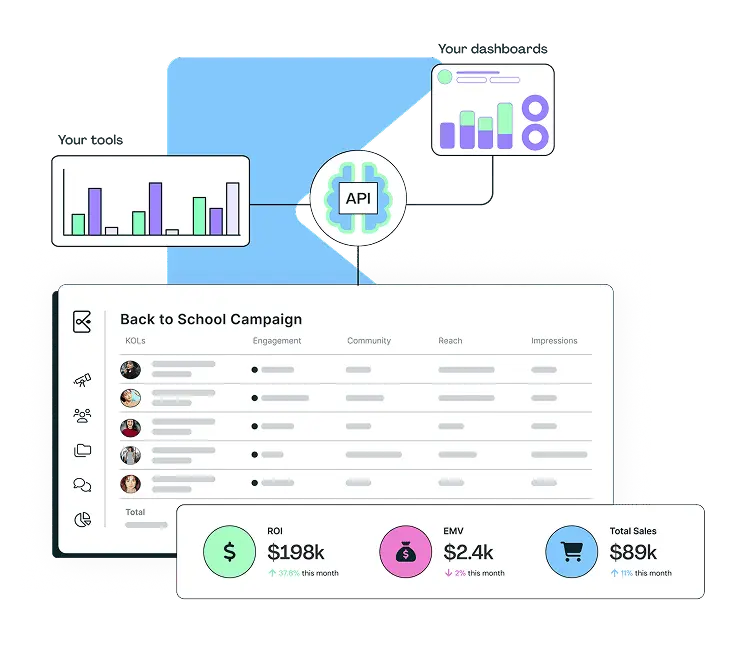
Influencer reporting on autopilot. Every metric that matters, instantly accessible.

What used to be a tedious task becomes your team’s secret weapon. With Kolsquare’s integrated reporting system, you get the insights you need to optimise faster, prove impact and scale what works.
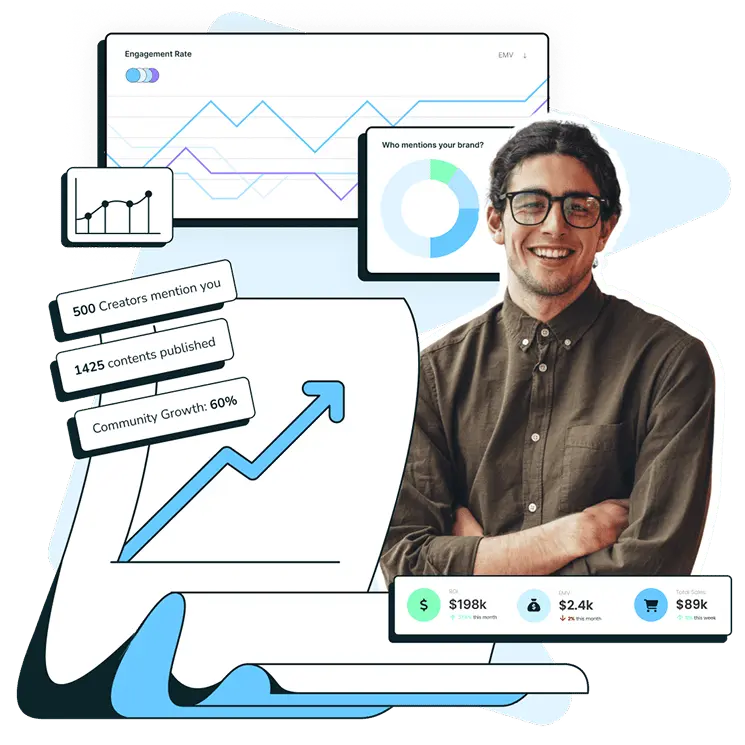
Meet the reporting system that does the heavy lifting for you

#1

Automatically track everything

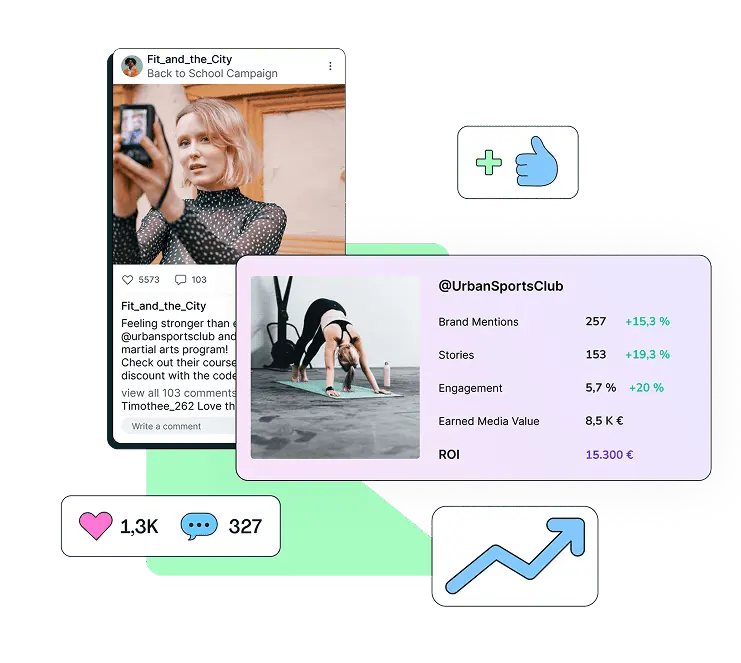
Chasing posts, screenshots or metrics can easily become a thing of the past. Kolsquare automatically collects all creator content and performance data across campaigns, giving your team a complete and reliable overview without the stress or extra hours.
#2

See the real ROI on your business

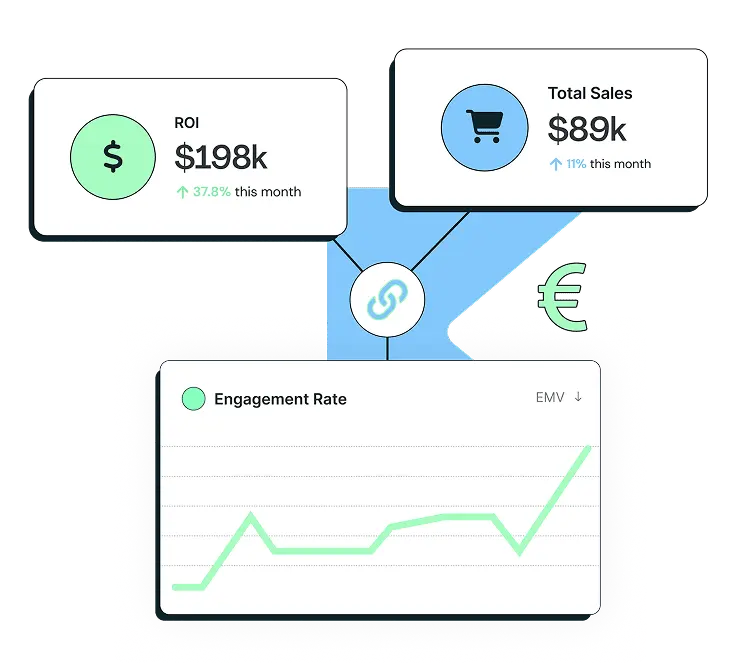
Look at the bigger picture and understand what creator marketing actually brings to your business. With Kolsquare, you can track conversions, traffic and revenue, and put them into context with qualitative indicators such as audience sentiment and engagement.
#3

Tailor-made reporting for each stakeholder, in seconds

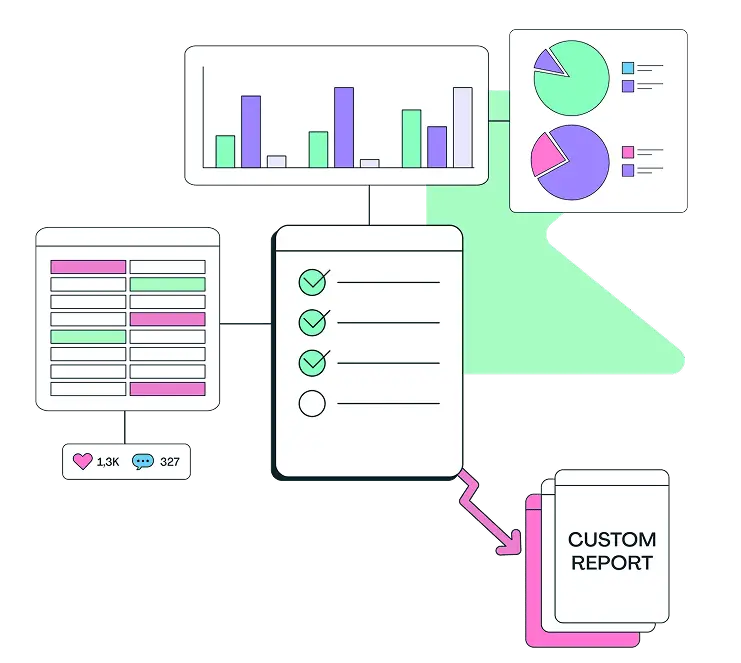
Quickly build reports adapted to people who will actually read them. With customisable KPIs, content selection and timelines, you keep teams and clients aligned with clear and comprehensive insights, shared instantly.

Confidence in every campaign, backed by data

Kolsquare tracks performance in real time so your team spends less time on admin and more time on decisions that actually matter.

+8 hours saved every week

On manual data collection and report creation

100% automated content tracking

All creator posts and performance data collected in one place

5x stronger ROI visibility

Track conversions, revenue and campaign performance in real time

Turn campaign data into performance intelligence

Ready to scale influencer marketing with confidence?

Speak with our experts and see exactly how Kolsquare fits your goals.

See how leading brands and agencies use Kolsquare

No two brands run influencer marketing the same way. See the ones doing it best through Kolsquare


Name

Job name

Name

Job name

❝

Working with nano creators means you don’t always have structured data available, so Kolsquare was really useful to centralise profiles, analyse their audience and engagement data, and validate our choices.

Clémence Pluijm

Influence Marketing Manager at Better & Stronger

❝

When you're working with a brand like Neutrogena, the stakes are high. You need to be able to show the client exactly why you've chosen each profile and what the data says about their audience. Kolsquare gives us that confidence.

Rocio Bustamante

Business Director and Head of Influence Marketing at Ogilvy Spain

❝

Now we make one payment to Kolsquare and I manage everything myself. I do the payments every month, and it's done in two clicks. Honestly, it's really simple and fast

Emma Biver

Influencer Marketing Manager at Wellness Pet

❝

Kolsquare really supports me in everything I do. It saves time, brings clarity and lets me be much more strategic.

Corentin Lardy

Marketing & PR Coordinator for France at Bestseller

❝

Kolsquare’s location data allowed each market team to confirm that their chosen creators were speaking to a genuinely local audience rather than a broad international one. That’s a really valuable insight.
Lea Ellul-Terranella

Social Media Specialist at Flying Tiger Copenhagen

❝

Before we booked anyone, we could look at a creator's last 30 to 90 days in Kolsquare and get a realistic read on viewership. The livestream numbers came in right where we expected, based on the creators we used.

Jake Gent

Head of Talent at Feenix Group

❝

What interests us is desirability. We seek to create activations that spark desire and spontaneity. Thanks to Kolsquare, we can refine our strategy, identify the strongest content, and adjust our approach for each campaign

Louise Safarti

Marketing Manager at Café Kitsuné

❝

Beautiful Things by Benson Boone had already been presaved thousands of times in France before the title was even released, so we knew there was something there, we just didn’t know who the fans were. By using Kolsquare to identify these four people

Ludivine Rome

Head of Digital for WEA at Warner Music France

❝

We love Kolsquare, it makes overseeing and evaluating multinational campaigns like the Aspen event really seamless.

Justine Provent

Head of PR and Social Media at Fusalp

❝

Kolsquare gives me the reassurance that we’re working with the right people. I can see audience credibility, filter by country, and double-check that a creator really has the reach and engagement they claim. It saves me hours of second guessing.

Marcom and Product Design at Kambukka

❝

The campaign required precise coordination—content approvals, posting schedules, and reporting. Kolsquare enabled real-time tracking, ensuring every deliverable was met.

Katia Wozniak

Consultant at Article Onze

❝

The added value of Kolsquare really revealed itself to us when it came to reporting to the client. We’re able to show them the overview of the target reached, estimated impressions, the best content, EMV, etc.

Mélanie Rodrigues

Head of Travel at Agence 14 Septembre

❝

We relied on Kolsquare’s keyword and filter tools to target influencers who perfectly fit the campaign’s needs, saving significant time and ensuring precision in our selections.

Álvaro Blanco

CEO of Native Media Group

❝

“Our local marketing teams might be working with a specific retailer in Hamburg, for example. With Kolsquare, we can go down to that level of detail — and actually find creators in Hamburg. That’s huge for us.”
Renee Kitchen

Head of Global Social Media & Influence at BIBS

Learn more about Kolsquare

Influencer Discovery

Search over 5 million+ of qualified creator profiles using the data, insights and AI-powered discovery tools that leading brands and agencies rely on.

Campaign Management

Empower teams and run all your creator campaigns in one place, centralising every step from outreach, casting and approvals to tracking, reporting and payments.

Competitive Listening

Understand your market, benchmark your performance with your competitive set and identify the opportunities that shape your next campaigns.

Discover our influencer campaign reporting tool

What are the 4 M’s of influencer marketing?

The 4 M’s provide a framework for structuring campaigns. They are make, manage, monitor and measure campaigns.

  • Make: Define objectives and design business models that link influencer content to growth.
  • Manage: Handle campaign management, from contracts to UTM parameters that track website traffic.
  • Monitor: Watch how the campaign progresses without over-reliance on vanity metrics.
  • Measure: Assess performance through engagement, conversions, and customer acquisition cost.

For first-time campaigns, the 4 M’s act as a checklist. They keep teams aligned, reduce wasted spend, and ensure influencer activity ties back to measurable business outcomes.

What are some influencer marketing platforms? What is TRIBE, Kolsquare, Upfluence, and Traackr?

There's really no "best" platform. It all depends on your requirements. Therefore, the first step is to think deeply about your campaign.

Do you want to work with many nano-influencers through affiliate links or a few collaborations with one mega-influencer through an ambassador program? 

On the other hand, are you thinking of launching a Gen-Z-targeted campaign through TikTok or an educational strategy through YouTube?

Once you understand what you want to achieve, you can pick a platform.

Here's what each one offers:

  • Kolsquare: Kolsquare covers everything. It has a huge database, including every influencer with over 5,000 followers in over 180 countries and helps you manage your campaign from start to finish. It is also ideal for brands that want a user-friendly interface or to expand their campaigns worldwide, especially throughout Europe. 
  • Upfluence: A good all-rounder with a large influencer list and campaign tools, but the interface might be complex and potentially expensive for smaller brands.
  • Traackr: Best for large enterprises with significant budgets that require advanced analytics and brand reputation management, but might be less user-friendly for smaller businesses.
  • Grin: A strong choice for brands seeking long-term partnerships with a variety of influencers across campaign sizes, but its European presence is less prominent.
  • TRIBE: With over 80,000 opted-in influencers, TRIBE is a platform that offers AI search, campaign management and reporting. 

All in all, Traackr, Upfluence, Grin, TRIBE, and Kolsquare all streamline campaigns, help you match with ideal content creators and launch highly effective campaigns.

The best way to decide? Try them! Book a Kolsquare demo today. No commitments, no charges.

Templates vs. influencer marketing software 2025: How do you create an influencer marketing report?

Creating an influencer marketing report with templates is possible, but limited. A spreadsheet can track vanity metrics, such as likes, comments, and reach, but struggles with providing deeper insights. Templates are static. They don’t update automatically or link campaign management data back to customer acquisition cost.

Influencer marketing software, by contrast, removes the guesswork. With a platform like Kolsquare, you can view audience demographics, campaign performance, and UTM parameters in real time. Graphs update as results come in. Reports aren’t just records, they become tools for optimisation.

This is especially useful for brands measuring first-time collaborations or checking for fake followers before investing more budget. Instead of manually comparing figures, you can export polished reports in one click.

The bottom line? Templates may work for small pilots. But once you scale, the right tool will ensure accuracy, consistency, and business models that support long-term growth.

How do you analyse an influencer campaign with an influencer marketing platform?

Analysing an influencer marketing campaign requires a nuanced approach, as the outcomes can be both tangible and intangible, each offering different insights into the campaign's effectiveness.

  • Define and track key metrics: start by identifying KPIs that align with your campaign goals. Tangible metrics include reach, engagement, click-through rates (CTR), and conversions (sales, sign-ups). These provide clear, quantifiable results that demonstrate the direct impact of the campaign on your business objectives.
  • Evaluate audience interaction: Beyond the numbers, assess the quality of engagement. Analyse comments, messages, and overall sentiment to gauge how the audience perceives the content. Positive or meaningful interactions often indicate a deeper resonance with the campaign, which can be just as valuable as raw engagement numbers. 
  • Measure brand awareness and sentiment: For less tangible outcomes, use social listening tools to monitor mentions, brand sentiment, and the broader conversation around your brand post-campaign. This helps you understand the campaign's impact on brand awareness and reputation, even if it doesn’t immediately translate into sales. 
  • Examine long-term impact: Look at the campaign’s effects over time. This includes tracking customer retention rates, repeat engagements, and ongoing brand mentions. The long-term benefits, such as increased brand loyalty or a strengthened brand image, are crucial for understanding the full impact of your influencer marketing efforts. Today, ROI can be tracked through links and promo codes. Earned media value (EMV) can also tell you how much the buzz from a campaign would have cost through traditional marketing channels. 
  • Gather influencer feedback: Engage with the influencers involved to gain insights into their experience with the campaign. Their feedback can provide valuable context to the data, revealing why certain content performed well and offering ideas for future optimisations.
  • Generate comprehensive reports: Finally, compile your findings into a detailed report that presents and interprets the data within the context of your broader marketing strategy. This report should guide future campaigns, highlighting what worked, what didn’t, and how you can refine your approach to maximise impact.

How do you measure the effectiveness of an influencer campaign?

The success of KOL marketing is rooted in the audience’s relationship with the KOL. But measuring that success isn't always easy.

Marketers approach influencer marketing with many different goals. And there are many trackable key performance indicators (KPIs). Some are related to the quantity and quality of audience interactions. Others focus on reach, or for sales-driven campaigns, sales tracking and conversions.

Below is the list of the most-tracked KPIs for influencer campaigns:

  • Engagements
  • Engagement rate
  • Reach
  • Impressions
  • Views and plays
  • Followers increase
  • User-generated content (UGC) produced
  • Cost per mile (CPM)
  • Conversions

What are the 3 Rs of influencer marketing?

The three Rs of influencer marketing campaigns are reach, relevance and resonance. They help brands create effective campaigns that truly impact their target audience.

Let's break down the three Rs of influencer marketing:

  • Reach: Selecting a few influencers with substantial followings or many influencers with small followings ensures your message spreads far and wide. The broader your reach, the more visibility your campaign will have.
  • Relevance: It's essential to choose influencers whose content aligns closely with or complements your brand and appeals to your target audience. Relevance should also include which platform you choose to launch your campaign on, whether that's Instagram or YouTube.
  • Resonance: Craft campaigns that deeply connect with the audience on an emotional or personal level. Resonance fosters genuine interest, encourages interaction, and builds long-term loyalty, turning followers into dedicated customers and brand advocates.

How do you analyse an influencer campaign?

Analysing an influencer marketing campaign requires a nuanced approach, as the outcomes can be both tangible and intangible, each offering different insights into the campaign's effectiveness.

  • Define and Track Key Metrics: Start by identifying key performance indicators (KPIs) that align with your campaign goals. Tangible metrics include reach, engagement, click-through rates (CTR), and conversions (sales, sign-ups). These provide clear, quantifiable results that demonstrate the direct impact of the campaign on your business objectives.
  • Evaluate Audience Interaction: Beyond the numbers, assess the quality of engagement. Analyse comments, messages, and overall sentiment to gauge how the audience perceives the content. Positive or meaningful interactions often indicate a deeper resonance with the campaign, which can be just as valuable as raw engagement numbers.
  • Measure Brand Awareness and Sentiment: For less tangible outcomes, use social listening tools to monitor mentions, brand sentiment, and the broader conversation around your brand post-campaign. This helps you understand the campaign's impact on brand awareness and reputation, even if it doesn’t immediately translate into sales.
  • Examine Long-Term Impact: Look at the campaign’s effects over time. This includes tracking customer retention rates, repeat engagements, and ongoing brand mentions. The long-term benefits, such as increased brand loyalty or a strengthened brand image, are crucial for understanding the full impact of your influencer marketing efforts.
  • Gather Influencer Feedback: Engage with the influencers involved to gain insights into their experience with the campaign. Their feedback can provide valuable context to the data, revealing why certain content performed well and offering ideas for future optimisations.
  • Generate Comprehensive Reports: Finally, compile your findings into a detailed report that presents and interprets the data within the context of your broader marketing strategy. This report should guide future campaigns, highlighting what worked, what didn’t, and how you can refine your approach to maximise impact.

How to run a successful influencer campaign?

Nobody wants to run a dud campaign. Whether that happens often hinges on data, specifically information about your current marketing efforts, target audience, social media platforms, key opinion leaders (KOLs), and more. Combining these insights with your well-earned marketing intuition means a campaign that can reach new heights and has a useful safety harness.

Start by clearly defining your goals, whether it's increasing brand awareness, driving sales, boosting brand affinity, or growing your social media following. This is also a good time to develop a campaign budget and pin down your target audience. Which platforms do they prefer? Are you targeting a specific audience segment? Which content types do they enjoy?

The next step is to carefully select the right influencers who align with your brand values and can authentically engage your target audience. This requires in-depth analysis and a true understanding of the influencer's abilities on different social media platforms.

Throughout the campaign, you should use data analytics and a continued reporting process to monitor performance, check you're hitting your targets, and make adjustments as needed. Consider which metrics meet your campaign objectives. For example, if your central goal is to dominate the conversation in your niche through your influencer campaign, conversions wouldn't be the most important metric. Instead, the focus should be on the earned media value you have gained and using social listening tools to assess the number of mentions you receive in comparison to other brands.

Comprehensive and accessible campaign reports are crucial for guidance; the more in-depth and user-friendly they are, the better they’ll help you optimize your strategy and achieve your campaign goals.

How do you track an influencer marketing campaign?

The KOL's relationship with their audience is a key factor in determining success in influencer marketing campaigns. KPIs, therefore, relate to the reach alongside the quantity and quality of audience interactions. Here, quality interactions would be comments, shares and saves rather than likes.

For influencer campaigns in which sales are the key objective, sales tracking and conversions are essential.

Below is a list of the most useful KPIs to consider when evaluating an influencer strategy:

  • Engagement: Track the likes, comments, shares, and saves your influencer marketing campaign generated. High engagement signals that the audience found the influencer's content relevant and compelling. Analysing the types of engagement and sentiment of comments also reveals deeper insights into how your audience connects with your brand.
  • Engagement rate: Measure the percentage of an influencer's audience that interacted with each post. The higher the engagement rate, the better. If more people interact with the influencer's post, it indicates a strong connection with the audience and content resonance. Comparing this rate across different posts and influencers helps identify the types of content that drive the most meaningful interactions.
  • Reach: Monitor the number of unique users who view your content. Reach helps you understand the visibility of your influencer marketing campaign. Increasing reach means increasing brand awareness, but you must ensure that you’re reaching the right audience.
  • Impressions: Count the total number of times your content is displayed, whether clicked on or not. A large number of impressions indicate strong content placement.
  • Views and plays: Track how many times your videos or stories are viewed and played. This metric provides insight into how enticing and engaging your content is. Many social media platforms also allow you to check the length of video views. Analysing drop-offs can help you find areas for improvement.
  • Followers increase: Monitor the growth in your social media following during and after the campaign. Follower growth indicates that your content or influencer partners have attracted new, interested users. Sustained growth throughout and post-campaign is a good sign that brand sentiment is good and your customer base is growing.
  • User-generated content (UGC): Measure the amount of content your audience creates around your campaign. An abundance of UGC content can be one of the best results from a campaign. UGC means the content truly affected the audience. In addition, it can help boost your campaign’s reach organically. This builds community, increases the reach of your campaign cost-free, and can even mean going viral.
  • Cost per mile (CPM): Evaluate how cost-effectively your campaign reaches 1,000 viewers or impressions. A lower CPM indicates better efficiency, allowing you to maximise your budget while maintaining wide exposure. This metric is essential for comparing the financial performance of different campaigns and influencers.
  • Return on Investment (ROI): Calculate the overall return on investment by comparing the campaign’s financial gains to its costs. ROI provides a clear picture of the influencer marketing campaign’s profitability. ROI tells you whether the campaign gains exceeded the cost.

Developing effective performance metrics is a crucial step in any campaign. Influencer campaign reporting tells you how your current campaign is performing and gives you the tools to run even more successful future campaigns. This is especially important as social media platforms mature and become more competitive and fast-paced.

What is an influencer campaign?

An influencer campaign is a type of marketing campaign where brands collaborate with influencers to promote products or services.

Influencer campaigns resemble traditional celebrity advertisements, but they offer a broader range of niches, pricing options, and creators. Marketers leverage the influencer’s credibility, audience bonds and reach to boost brand awareness, customer relationships and sales. It’s about tapping into influencers’ audiences to connect with potential customers in a more authentic and impactful way.

Done right, influencer campaigns can rocket brand visibility and influence in the market. 

Here are a few of the most popular influencer marketing campaign types:

  • Sponsored content: Brands pay influencers to create content that promotes their products or services. The content could be posts or videos on any platform, from Instagram to TikTok. Sponsored content campaigns give brands more creative control. They can work closely with influencers to develop content and contracts. A sponsored post should seamlessly integrate the ad into the influencer’s regular content, maintaining authenticity while delivering a clear marketing message.
  • Giveaways or contests: Influencers collaborate with brands to host giveaways or contests that encourage followers to engage by liking and sharing the content or tagging friends to enter. These campaigns increase brand visibility, driving engagement, and rapidly growing a social media following. The added incentive of winning a prize often leads to a flurry of activity and user-generated content, which helps boost reach.
  • Affiliate marketing: For affiliate campaigns, influencers promote products alongside a unique link or discount code, earning a commission for each sale made through their link. This type of campaign drives sales and allows brands to track the direct impact of the influencer’s efforts.
  • Gifting campaigns: In these campaigns, brands send influencers free products. The brand will likely have less control over content in this type of campaign, but the low costs keep it a desirable option. Influencers often thank the brand by posting content, unboxing the product on camera or providing a detailed review. This is especially useful for building hype around new products because customers gain a firsthand look at the product, increasing anticipation and trust.
  • Long-term partnerships: Some brands form long-term relationships with influencers, turning them into brand ambassadors. In this setup, influencers feature the brand in their content over an extended period. This develops a strong audience-brand connection. As a result, brands must start these campaigns with extensive due diligence. These programs have huge potential with the right influencer, but a poor choice can damage the brand's reputation.
  • Event-based: Here, brands invite influencers to participate in or promote an event, such as a product launch, store opening or influencer getaway. The influencer then shares their experience with their followers, helping to draw attention to the event and brand. Event-based campaigns are excellent for generating excitement, creating brand stories and providing a real-time look at a brand’s behind-the-scenes activities.

Ready to scale influencer marketing with confidence?

Speak with our experts and see exactly how Kolsquare fits your goals.