Log in

English (UK)

×
![Image affichée dans la lightbox]()
Gaming influencer marketing in practice: how Feenix Group built a six-beat Nintendo Switch 2 campaign for Smyths Toys
Most gaming campaigns are still built as one moment: one creator, one video, one launch date. Feenix Group took a different route for Smyths Toys Superstores. Six beats, five creators, and Twitch doing work that short-form video could not.
Posted On
September 8, 2026
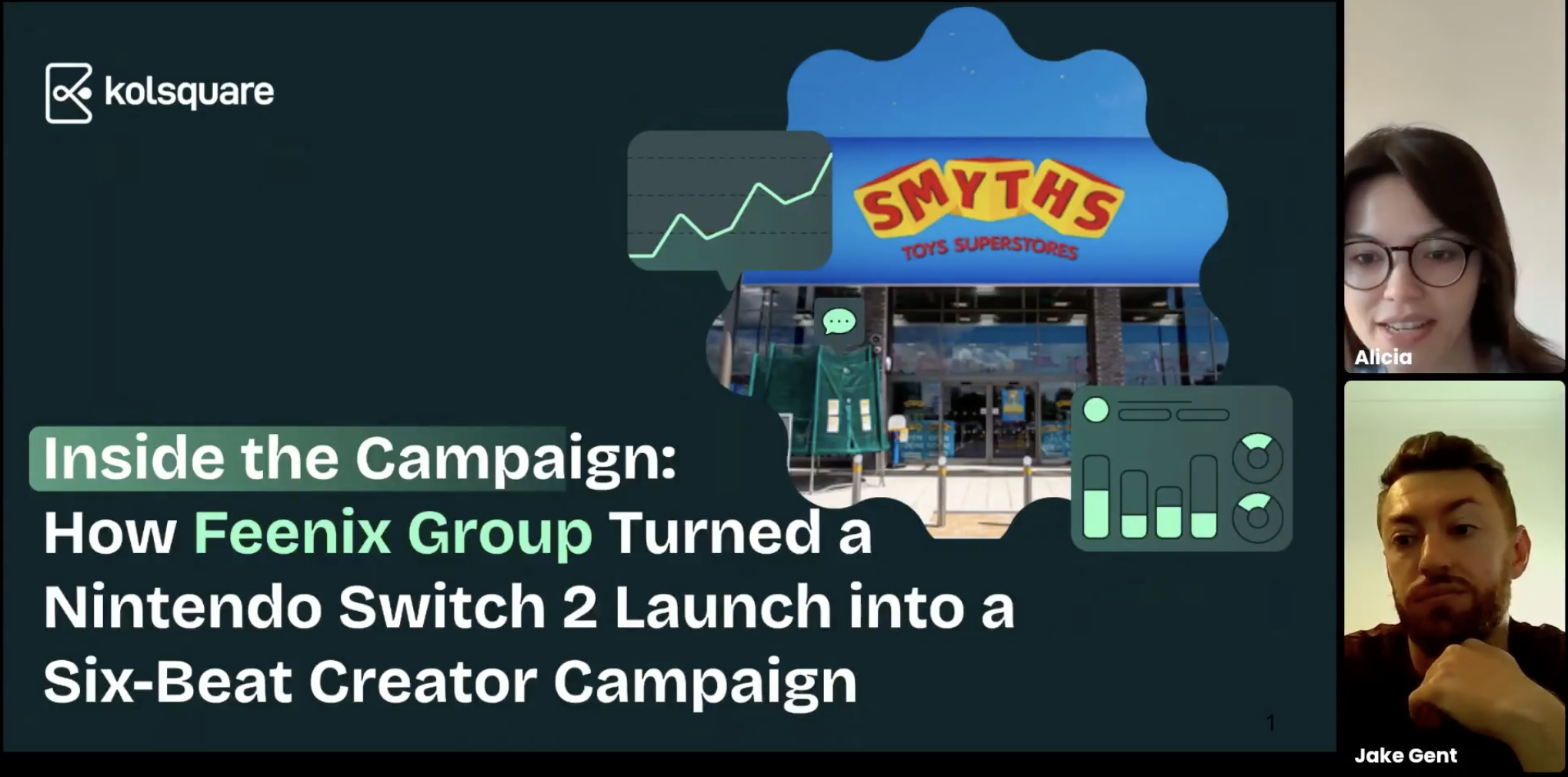
Inside the Campaign How Feenix Group Turned a Nintendo Switch 2 Launch into a Six-Beat Creator Campaign
In our latest webinar, Jake Gent, Head of Talent at Feenix Group, walked through how the campaign came together, in conversation with Alicia Van der Meer, Field Marketing Team Lead and UK Marketing Manager at Kolsquare. A 5.4% engagement rate on social content, one strong creator cut from the roster mid-campaign, and a brief that ran backwards.
Why a toy retailer went after a gaming audience
Smyths Toys Superstores is the UK’s largest toy retailer, and gaming is a substantial share of the business. That makes a console launch less of a stretch than it first sounds.
Feenix Group works with gaming creators and streamers as its core specialism, holding both an exclusive roster and non-exclusive talent relationships. As Jake put it, the fit “combined our experience with gaming and influencers, and it was quite a natural fit with them as a brand and what they were trying to do with the Nintendo Switch 2 launch.”
The Nintendo Switch 2 arrived in June 2025 and set a UK launch record for a Nintendo console, roughly doubling the original Switch’s opening week. Sustaining that interest through the game releases that followed was the commercial opportunity.
The brief: awareness first, conversions later
The objective was to amplify the console launch and hold that momentum through follow-up game launches in the months after. No discount codes. No purchase incentives.
“Conversions are usually driven through products with discount codes and incentives for people to buy. As this was a product launch, it had just come out, so that wasn’t going to be possible. This was more about focusing on awareness and understanding of the product, its capabilities, and then trying to influence those purchases and decisions more long term rather than just at the launch.”
Jake Gent, Head of Talent, Feenix Group
That is a different measurement conversation from a conversion-led activation, and worth being explicit about with stakeholders before the campaign starts. If the KPI is long-term consideration, a last-click report will make good work look poor.
Why the console launch got the biggest creator budget
Feenix Group put its two largest creators behind the console launch rather than spreading budget evenly across all six beats. The reasoning was sequencing.
“We knew the console launch was going to be the biggest part of it. Every other beat after that almost followed on from it, so it was reliant on the console launch being big, people knowing it, people having the console. These sorts of console launches don’t come around that often, usually every few years. So we knew it was going to be the one that would gather attention.”
If the hardware moment fails to register, the five beats behind it have nothing to build on. Weighting the headline beat buys the widest reach at the point where audience interest is already peaking, and hands the follow-up beats a warmer audience.
The Princess Peach cosplay: where the idea actually came from
The cosplay concept is the campaign’s standout creative moment, and it did not come from the client or the creator. It came from the agency, out of a working relationship that predated the brief.
“It was actually my idea, I don’t want to take too much credit. When we initially scoped out the campaign, I’d worked with her for years, so I knew she was a big Nintendo fan. I knew she’d already cosplayed Peach and other similar characters, so I knew it would be a good fit from both what we were trying to achieve and from her audience and content.”
That is the part worth stealing. The idea was low-risk because Feenix already had years of evidence about what this creator’s audience responds to, so nobody had to guess whether cosplay would land.
Execution was then handed over almost entirely:
“She was given quite a lot of freedom on it. There was obviously a set brief and key messaging to include, but it was really down to her to decide what she thought would best resonate with her audience. The brief was quite lax on this one, which we did purposefully, just to give her the best chance of coming up with something that she knew would resonate.”
The brief that ran backwards
For the cosplay beat, Feenix inverted the usual sequence. Rather than scripting the content and sending it out, they briefed the outcome and asked the creator to script it back.
“We’re not giving a creator a script and asking them to read it and record a video line by line. For this specific one, we flipped it on its head. We gave the creator the brief, and then we asked her to come back to us with their creative concept and a rough storyboard, which we could then get approved and make sure the client was happy with.”
Alicia’s response to that was the most quotable line of the session: “I haven’t heard that in a while, where instead of the brand or an agency giving the brief, it’s the other way around. That’s one to test.”
The approval step matters. Creator-led concepting is not the same as sending content live unchecked, and the storyboard gate is what makes it viable for a brand with real guidelines.
Casting: the strong creator who did not make the cut
The final roster was not the original one. Feenix started with more creators across more gaming niches, then narrowed it using performance data from the earliest beats alongside content fit.
The clearest casualty was an EAFC creator, dropped for reasons that had nothing to do with quality.
“We had a really strong EAFC creator, previously FIFA. There was originally going to be a beat that focused on hardware products alongside the console, and it actually coincided with the launch of FC 26. We knew that creator had a strong audience within EAFC and we knew that with it being on the Switch 2, it was going to be a good combination. But then that beat changed and we had to focus on a game launch instead, so that game wouldn’t have been the right fit for that creator and the audience he had.”
A creator can be right for a campaign and wrong for a beat. When the calendar moves, fit has to be re-checked rather than assumed, which is a cost most campaign plans do not budget for.
Matching creators to games
Where the roster did hold, it held because Feenix knew the creators well enough to place them.
“I knew for example with the Pokémon beat, three of those creators were massive Pokémon fans and they were going to be a great fit. So part of it is knowing your creators and knowing what they can authentically talk about, rather than trying to shoehorn them into a campaign just for the sake of it. We wanted to make it feel like they didn’t have to go out of their way to make content on it. It would come across as natural to the viewers that they knew what they were talking about.”
What holds a six-beat campaign together
Six beats is where creator campaigns usually start to feel like a template. Feenix’s answer was consistency in the brief and variety in the roster, which sounds contradictory until you see where each one applied.
The brief stayed fixed:
“That brief didn’t change no matter what the beat was. The only thing that changed was what the focus of that beat was. Everything else stayed the same and they had the freedom to fit something around their style and audience, but it always tied back to the objectives of the campaign.”
The creators did not:
“Giving creators more freedom helped them come up with a new concept, helped them do something different each time, rather than giving them a really strict script they had to follow. That’s when it becomes quite obvious it’s a branded video and a branded campaign, and then you get into the realm of repetitive content.”
The planning burden is real. A multi-month brief means more work upfront, a separate creator-fit decision per beat, and enough slack to absorb a shifting release schedule.
“With a one-off campaign it’s usually pretty set in stone at the beginning of what’s going to be delivered, and you commit to that and you deliver it. Whereas with this, there was more opportunity for things to move around and be flexible, which means you have to be a bit more agile.”
What live streaming does that short-form cannot
Short-form video buys reach. Live streaming buys time.
“With a short form video it might be 30 or 60 seconds, and a viewer might only be watching for a couple of seconds before they’ve scrolled onto something else. With streaming we can make that viewer last longer on the content, and for something like a new product launch it gives them a better chance of understanding the product, understanding what it can do and being able to visualise it in real time, rather than a short form video that might just be cut up in an edit.”
For a hardware launch that needs explaining, that difference does the work.
Live also runs in more than one direction. Viewers ask questions in chat and the creator answers mid-stream, but the more interesting behaviour is between viewers:
“It also gives other viewers the chance to communicate with each other a bit more. A lot of the time people will be having their own conversations in the chat while the creator is doing something on stream, and that creator doesn’t necessarily have to engage with them. They’re answering their own questions and they’re speaking to each other while it’s going on.”
A short-form post cannot answer a question about backwards compatibility. A chat can, in real time, in front of everyone else wondering the same thing.
Why the campaign combined live and short-form rather than picking one
Feenix considered running the whole thing live and decided against it, deliberately rather than by default.
“We know a fully live-streamed campaign would deliver really high engagement, positive sentiment and consideration. But because it was a launch of a console and we wanted that awareness and that reach and viewership, we combined the two rather than doing one of them in a silo. They complement each other.”
Tapping a subathon for the final beat
The last beat landed inside a Twitch subathon, a format where a streamer stays live for a prolonged period and audience engagement extends the stream, sometimes for days or weeks. Placing the beat there was opportunism rather than strategy, and Jake said so.
“It was probably just good timing rather than anything overly clever. When we found out what the final beat was going to be and when it was going to fall, I knew Hefty was in the middle of a subathon at that time. With a subathon we know viewership is going to be high and audience engagement is going to be higher. So we were able to tap into that and capitalise on it by fitting this beat into the subathon that we already knew was happening.”
Worth noting as a planning habit: a creator’s own content calendar can be a media opportunity, and it costs nothing except knowing it is happening.
The results: 5.4% engagement rate against a 1% to 3% benchmark
Live-streaming performance came in line with forecasts built from creator viewership over the previous 30 to 90 days, which is the outcome you want on a channel that is harder to model than social. Jake also noted that streaming numbers have grown since, as the format has become more embedded in campaigns.
The social content went further.
“This is probably considerably higher than most. An average range is usually somewhere between 1 and 3%. We know a sponsored campaign and a branded campaign is going to be lower than a traditional piece of content from a creator. So this was higher than we were expecting.”
The campaign recorded a 5.4% engagement rate, against that 1% to 3% benchmark for branded gaming content.
Engagement rate is not a business outcome on its own. What it evidences here is that creator-led concepting and a rotating roster produced content audiences chose to interact with. On an awareness brief with no discount code doing the heavy lifting, that is the signal worth reporting.
Why Twitch performed best on clicks and conversions
Asked which platform led on conversions and clicks, Jake named Twitch, and the reason is mechanical rather than cultural.
“That’s the one where we can put a link directly into the chat and people can click through it. We know TikTok is great for short form social content, but to then get someone to click a link, they usually have to go back to the bio and click a link there rather than being able to do it directly.”
Twitch chat, in his framing, “becomes a mechanic for engagement with a brand.” He also cited a figure worth checking against a current source before you quote it in a deck: around 50% of Twitch viewers watch roughly eight hours of live streaming a week.
What Feenix would change: in-stream ads
The social approach would stay broadly as it is. The change would be giving live streaming a larger role through in-stream advertising, a Feenix product that did not exist when the campaign ran.
“It can be done at set intervals throughout, so every 10 to 20 minutes an ad could pop up for a specific brand. In this case it would have been a picture of a Switch 2, which was interactive, with a link alongside it in the chat. We can also do it based on triggers within the streams. If the streamer said the words Nintendo Switch 2, it could pop up. If someone in the chat commented Nintendo or Switch 2, it could pop up as well.”
The scale argument is the point:
“With individual creators, they’re great, they’re sponsored streams, that’s a creator streaming something specifically for a few hours. Whereas with this we can target a much wider pool of streamers, so it could have been 100, a couple of hundred streamers involved, all serving the same ad.”
That widens the addressable audience without dismantling the creator partnerships that generated the engagement in the first place.
What brands still get wrong
Asked by an attendee what brands and agencies most often get wrong on creator campaigns, Jake went straight to the brief.
“It’s around being too strict with the brief and what they’re expecting a creator to deliver. For a brand that wants to authentically reach an audience, you need to give that freedom back to the creator on what they deliver and how they deliver it. They’re the ones that have built that audience. They’re the ones that know their viewers and why they engage with them.”
Alicia’s addition named the commercial cost of getting it wrong: treating creator campaigns as a media buy rather than a relationship, briefing twenty creators identically and waiting for the content to arrive. “If you’re handing out the same script to 20 creators, you’re paying influencer rates for stock footage.”
The takeaway: live streaming belongs in the core channel mix
“Streaming needs to be considered as integral to these campaigns. It’s one of those social channels that we use, rather than it just being short form content on specific channels. It’s building as part of it rather than being a separate thing.”
Short-form still does its job on reach. Live adds sustained attention, two-way conversation, a click that sits one tap away, and a community watching together. For toy retailers, gaming brands and anyone targeting a younger audience, that makes Twitch a primary channel rather than a test.
Reporting has been the practical obstacle: streaming has historically sat outside the same view as everything else. Twitch is now part of Kolsquare’s cross-platform analytics, so Twitch creators can be discovered, analysed and reported alongside every other channel rather than in a separate spreadsheet.

Frequently asked questions
Does live streaming work for influencer marketing campaigns?
Yes, and it performs differently from short-form. Live streaming holds viewer attention for longer, allows real-time questions and answers about the product, and lets brands place clickable links directly in chat. In Feenix Group’s Nintendo Switch 2 campaign for Smyths Toys Superstores, Twitch delivered the strongest click and conversion performance of any platform used.
What is a good engagement rate for a gaming influencer campaign?
Branded gaming content typically sits between 1% and 3%, because sponsored content usually underperforms a creator’s organic posts. The Feenix Group campaign reached 5.4%, which the team attributed to creator-led concepting and rotating creators across campaign beats rather than repeating one format.
Should gaming brands use Twitch or short-form video?
Both, for different jobs. Short-form delivers reach and awareness efficiently. Twitch delivers dwell time, real-time interaction and easier click-through, because links can sit in chat rather than behind a bio link. Feenix Group considered running this campaign entirely on live streams and chose to combine the two, on the basis that a console launch needed short-form’s reach as well as live’s depth.
How much creative freedom should a creator brief allow?
Enough that the creative concept can come back from the creator. Feenix Group supplied key messaging and brand guidelines, then asked the creator to return a concept and storyboard for approval before production. The approval gate is what makes the freedom workable for a brand with guidelines to protect.
How do you plan a multi-month influencer campaign?
Weight budget towards the beat everything else depends on, select creators per beat rather than booking one roster for all of them, keep the brief itself constant while the beat focus changes, and expect to re-check creator fit when release dates move. On this campaign, a strong EAFC creator was dropped because the beat he was cast for changed shape.
What is a Twitch subathon?
A stream that runs for a prolonged period, where audience engagement and subscriptions extend the runtime, sometimes for days or weeks. Viewership and engagement run higher than a standard stream, which makes an existing subathon a useful window for a campaign beat.
What are in-stream ads on Twitch?
Interactive ad formats that appear inside a live stream, triggered at set intervals, by keywords spoken by the streamer or typed in chat, or by in-game events. They let a brand reach a broad pool of streamers with one creative, rather than negotiating individual creator partnerships for each.
Watch the full webinar
Jake Gent and Alicia Van der Meer go through the campaign structure, the creator shortlist, the casting decisions that changed mid-campaign and the full performance breakdown.
Watch the replay and see the full campaign breakdown.
If you want to walk through how you would measure a campaign like this one, get in touch with the Kolsquare team
About Kolsquare
Kolsquare is Europe’s leading Influencer Marketing platform, offering a data-driven solution that empowers brands to scale their KOL (Key Opinion Leader) marketing strategies through authentic partnerships with top creators.
Kolsquare’s advanced technology helps marketing professionals seamlessly identify the best content creators by filtering their content and audience, while also enabling them to build, manage, and optimize campaigns from start to finish. This includes measuring results and benchmarking performance against competitors.
With a thriving global community of influencer marketing experts, Kolsquare serves hundreds of customers—including Coca-Cola, Netflix, Sony Music, Publicis, Sézane, Sephora, Lush, and Hermès—by leveraging the latest Big Data, AI, and Machine Learning technologies. Our platform taps into an extensive network of KOLs with more than 5,000 followers across 180 countries on Instagram, TikTok, Twitch, Facebook, YouTube, and Snapchat.
As a Certified B Corporation, Kolsquare leads the way in promoting Responsible Influence, championing transparency, ethical practices, and meaningful collaborations that inspire positive change.
Since October 2024, Kolsquare has become part of the Team.Blue group, one of the largest private tech companies in Europe, and a leading digital enabler for businesses and entrepreneurs across Europe. Team.Blue brings together over 60 successful brands in web hosting, domains, e-commerce, online compliance, lead generation, application solutions, and social media.

Author


Questions & réponses
No items found.


.webp)

NEXT IN INFLUENCE
The must-read newsletter for influencer marketers
Your monthly dose of exclusive insights, strategies and trends shaping the creator economy. For insiders, by insiders.
L’essentiel, directement dans votre boîte mail.
.webp)