

The Budget Report 2027: why bigger influencer budgets feel smaller
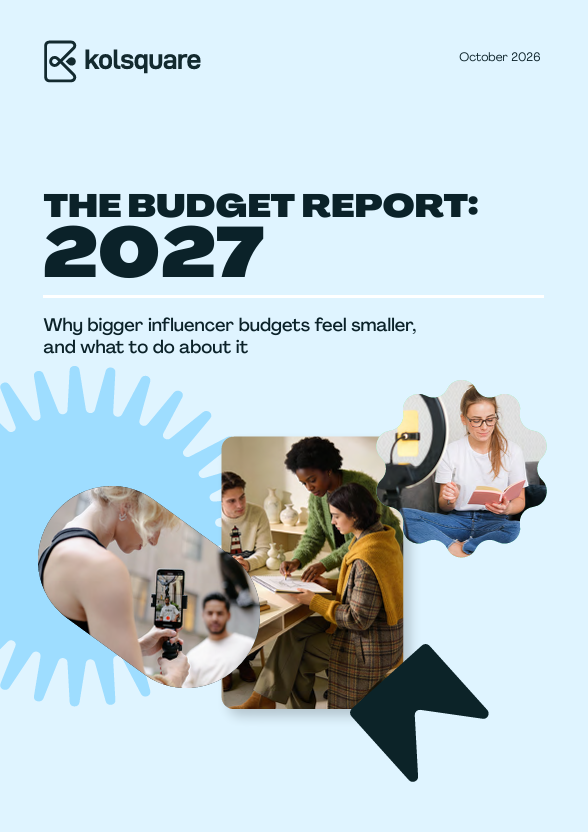
89% of brands plan to raise their influencer marketing budgets in 2027. Yet creator fees and social ad prices are rising faster, so bigger budgets don't feel bigger. The Budget Report 2027 shows where the money is really going, what one piece of influencer content is worth in the UK by creator tier, platform and format, and how to build a 2027 budget you can defend.
What influencer marketing really costs in 2027, what one piece of content is worth in the UK, and what to do about it
Influencer marketing budgets in 2027: why more money doesn't mean more room
2027 budgets are being set this quarter. And they're being set in a market where money isn't the issue: every pound simply buys less than it used to.
In the UK, advertising investment in creator partnerships will jump 26% in 2026 to reach £1.217bn, according to the IAB. Appetite is among the strongest in Europe: 93% of UK brands and agencies plan to raise their influencer budgets over the next 12 months, against 89% across the seven markets in Kolsquare's The Future of Influencer Marketing 2026/2027 study.
Median influencer marketing budgets rose from €127,000 in 2025 to €144,000 in 2026 on a like-for-like basis, and reached €367,000 at enterprise companies.
The problem is that costs are rising faster. Creator fees, production, IRL events and the ads that amplify content are all getting more expensive. The Budget Report 2027 explains why, and what to do about it.
Why is influencer marketing getting more expensive?
Rising costs now top the list of challenges cited by influencer marketers: 29.4% name them as a key challenge for 2027, rising to 33% at companies with fewer than 50 employees.
Roster growth is a big driver. The share of companies working with 100 or more influencers has nearly doubled since 2024, from 18% to 37%, and 85% of brands and agencies plan to grow their rosters again in 2027. Micro-influencers do most of the heavy lifting, with 71% of brands now working with them. But as micro fees rise, "cheap at scale" no longer holds: larger rosters now add cost faster than they add reach.
Amplification is getting pricier too. Meta's average price per ad rose 12% year on year in the first quarter of 2026, and TikTok CPMs rose roughly 12–16% across independent ad-tech benchmarks.
What is one piece of influencer content worth in the UK?
Cost is only half the budget equation. The other half is what content returns. The Budget Report 2027 includes an exclusive content value grid: the earned media value (EMV) of a single piece of content by creator tier, platform and format, built by Kolsquare from 535 creators with at least 30% of their audience in the UK, across 594 Instagram, TikTok and YouTube accounts. You won't find this data anywhere else.
Here's an excerpt for micro creators (10k to 100k followers):
Half of all content falls between the lower and upper quartiles. Median CPM is EMV per 1,000 estimated views. Instagram Stories are valued at a fixed rate per 1,000 estimated reach, so no CPM is shown. Figures converted from euros at £0.8571. Source: Kolsquare data, September 2026.
The full grid covers all five tiers, from nano to mega, on all three platforms. Three takeaways stand out:
- Same tier, same fee, very different value. Two UK micro creators who each quote £1,000 for an Instagram post can land near £865 or near £2,252 in EMV: more than two and a half times the value.
- Format matters as much as the creator. For a micro creator, a YouTube video (median £2,552) delivers more than twice the value of an Instagram Reel (median £1,117).
- CPM puts creator content next to paid media. Per 1,000 views, value ranges from £58–£75 for Instagram posts and Reels in most tiers to more than £450 for long-form YouTube in every tier.
Investment is outpacing integration
79% of brands treat influencer marketing as a core or important channel. Only 10% say it is fully integrated into their marketing mix. The money is moving faster than the organisation.
The tooling is catching up. The share of brands using a dedicated influencer marketing platform jumped 26 percentage points in 2026, and 84% of organisations use AI or automation in influencer workflows. The UK is among the heaviest users in Europe, with 44% using AI extensively. Yet only 13.9% of those using AI apply it to predictive analytics. Payment models are diversifying too: fixed fees per post remain the most common, but commission, long-term contracts and hybrid models are now mainstream.
The report details three case studies: L'Oréal and its "share of influence", More Nutrition and its commission-only model, and Neutrogena's Collagen Bank launch, tracked end to end on a single platform.
2027 priorities to make your budget work harder
- Budget for value, not volume. Fewer, better-matched creators on longer contracts.
- Benchmark every quote before you sign. Compare it with creators in the same tier and format, and check where their recent content sits in the range.
- Choose the format for the objective, then check its value per 1,000 views.
- Ring-fence your amplification budget and put paid reach behind proven content.
- Agree shared KPIs before the campaign with your paid, CRM and brand teams.
- Report awareness in EMV in every campaign report, so top-of-funnel work isn't the first line cut.
Key numbers
- £1.217bn UK investment in creator partnerships in 2026, up 26% (IAB)
- 93% of UK brands and agencies plan to increase their influencer budgets over 12 months
- €144,000 median influencer marketing budget in 2026, up from €127,000 in 2025
- 37% of companies work with 100 or more influencers, up from 18% in 2024
- +12% average Meta ad price, first quarter of 2026
- 10% of brands say influencer marketing is fully integrated into their marketing mix
- 535 UK creators analysed for the content value grid
Frequently asked questions
How much should brands budget for influencer marketing in 2027?
The median influencer marketing budget reached €144,000 in 2026, up from €127,000 in 2025 on a like-for-like basis, according to Kolsquare's The Future of Influencer Marketing 2026/2027 study. At enterprise companies, median spend hit €367,000. For 2027, how the budget is split matters as much as its size: creator fees, paid amplification, production and tools. The Budget Report 2027 gives cost and value benchmarks to make those calls.
Will influencer marketing budgets increase in 2027?
Yes. 89% of brands and agencies across Europe plan to raise their budgets over the next 12 months, and 93% in the UK, up from 75% in 2025 and 54% in 2024 across the panel. UK investment in creator partnerships is set to reach £1.217bn in 2026. But costs are rising faster, from creator fees to Meta ad prices, which rose 12% year on year in early 2026.
Why is influencer marketing getting more expensive?
Three forces combine: bigger rosters, rising micro-creator fees and more expensive amplification. The share of companies working with 100 or more influencers rose from 18% in 2024 to 37%, Meta's average price per ad rose 12% and TikTok CPMs rose roughly 12–16%. As a result, 29.4% of marketers cite rising costs as a key challenge for 2027.
How much is one piece of influencer content worth in the UK?
For UK micro creators (10k to 100k followers), median EMV is £1,384 for an Instagram post, £1,117 for a Reel, £513 for a TikTok video and £2,552 for a YouTube video, according to Kolsquare data on 535 UK creators. Ranges are wide within a single tier: half of all micro Instagram posts land between £865 and £2,252. The full grid, from nano to mega, is in the Budget Report 2027.
What is EMV and how is it calculated?
Earned media value (EMV) estimates the media value of a piece of influencer content. Kolsquare gives each like, comment, share and view a monetary value from the Ayzenberg social media value index, then adds them together. EMV isn't revenue, and it isn't what creators charge: it's a way to rank bookings against each other and put a number on top-of-funnel work.
Which influencer content format delivers the most value?
It depends on the objective. Per 1,000 views, value ranges from £58–£75 for Instagram posts and Reels in most tiers to more than £450 for long-form YouTube in every tier. Short formats deliver fast reach around a launch; content aimed at consideration needs a format that holds attention. Set the objective first, then check the format's value against it.
How can brands keep creator costs under control?
Long-term partnerships are the clearest hedge. "The best ROI is seen in the 3–6 month partnership," says Klara Verzele, founder of KLARENCE. Commission and hybrid deals also tie cost to outcome: More Nutrition built a €1bn supplement brand on a flat 10% commission, with no flat fees.
Which creator payment model should brands use?
Match it to the funnel stage: fixed fees for awareness, commission or affiliate deals for conversion. Then centralise reporting for each phase so results can be compared.
Sources: Kolsquare, The Budget Report 2027; IAB UK; Kolsquare, The Future of Influencer Marketing 2026/2027 (B2B International, 1,123 respondents); Kolsquare data, 535 UK creators, September 2026.
Download the Budget Report 2027
The full UK content value grid (five tiers, three platforms, six formats), cost data, three case studies and the priorities for 2027. Everything you need to build a budget you can defend.

Questions & réponses
Never miss a beat with our newsletter !
Your monthly dose of exclusive insights, strategies and trends shaping the creator economy. For insiders, by insiders.
L’essentiel, directement dans votre boîte mail.