Ready to elevate your marketing game with Influencer Marketing?
Our team of experts will be happy to show you our influencer platform in action and discuss your individual needs and aspirations.



At MADfest this July, on the Creator Economy Stage, Kolsquare VP of Global Voices Eugen Knippel and FreeSoul Head of Influencer Marketing Fiona Macpherson took aim at the most common line in the industry: "be authentic". Their argument was simple. Authenticity isn't something you can instruct at the brief stage. It's set much earlier, through casting, product fit and creative freedom.
Here are the 10 learnings worth taking back to your next campaign.
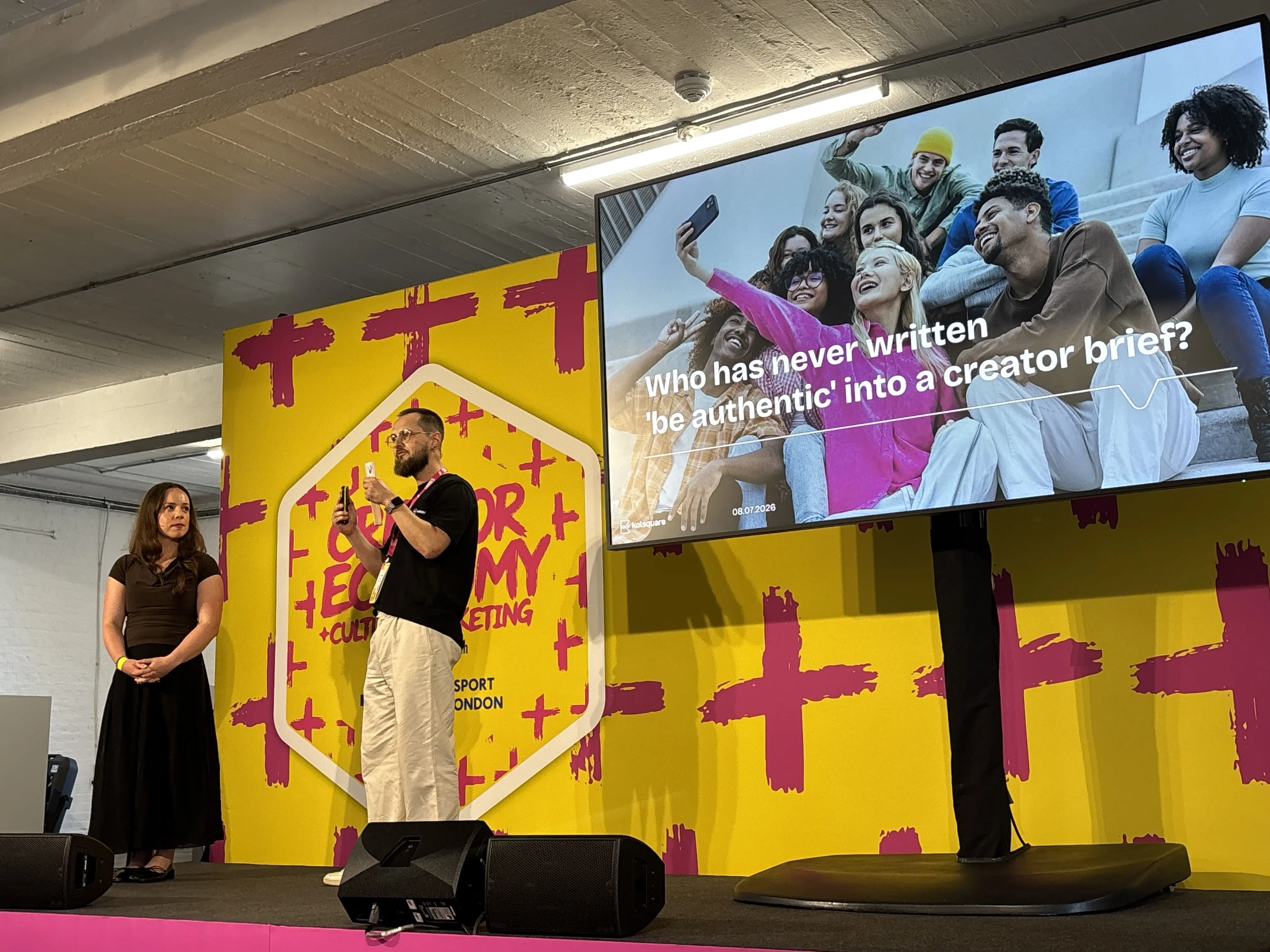
Telling a creator to "keep it authentic" or "make it feel genuine" asks them to perform sincerity on command. That's the exact thing audiences have learned to spot. Two of the most common brief lines in the industry are also two of the least useful.
Research from Georgia State University's Robinson College of Business splits creator authenticity into five parts: expertise (built over months of real use), connectedness (an existing bond with their audience), originality (their voice, not a script), transparency (disclosed plainly) and integrity (passion that predates the deal). Every one of them is set before the deal. A line in the brief adds none.
One genuine strength offsets a gap elsewhere. A creator with deep expertise can get away with a smaller audience bond, and vice versa. That's why who you cast matters far more than how tightly you brief.
Sincerity makes people listen. Credibility makes them act. A warm, likeable creator promoting a product outside their lane gets trusted as a person, not as a source, so the content is liked but not actioned. The posts that convert come from a genuine voice backed by real experience in the category.

This is the whole point. Casting, product fit and creative freedom are the only things that add the five properties. If you get the casting right, you don't have to ask for authenticity. If you get it wrong, no brief line will save it.
Run a keyword check across their organic content, including political and values-led posts, and review their brand collaboration history. Are the partnerships well matched, or does the feed read like a rolling ad break? Real alignment shows up in what they do when no one's paying them.
Engagement rate is a useful community signal, but comment sentiment is where you see whether the trust is real. Look for genuine questions and shared experiences, not bots and emoji. The dashboard can't tell you that.
The longer and more prescriptive the brief, the more you strip out the voice you hired the creator for. Give the non-negotiables — disclosure, claims you can't make, the core message — and then stop.
A word-for-word script guarantees the stiff, read-off-the-card delivery audiences discount on sight. Hand over the message, not the sentences, and trust creators to know what performs with their own audience.
Don't soften or bury the ad label. 80.1% of UK consumers want creators to state clearly when content is advertising (source: GWI / ONIM, 2025), and the ASA requires it anyway. One caveat the talk was honest about: even a perfect, well-cast, fully disclosed post can get discounted when a category is flooded with sponsored content. Briefing for credibility fixes the creator relationship. It can't fix channel-level saturation on its own.
Source: GWI / ONIM consumer data, 2025.
Because it asks them to perform sincerity on command, which is exactly what audiences have learned to spot. The instruction can't add expertise, an audience bond or genuine passion. Those come from who the creator is, set at casting rather than in the brief.
Give the non-negotiables — disclosure requirements, claims to avoid, the core message — then get out of the way. Keep it short, skip the script and leave room for the creator's own voice.
Look past follower count. Check what they post organically, review their collaboration history, use engagement rate as a community signal and read comment sentiment. An honest check on whether their values match yours matters too.
The audience data says yes. Content that feels authentic earns attention, while too much obvious sponsorship and untrustworthy recommendations drive people to unfollow.
The budget, ROI and audience benchmarks referenced in the talk come from Kolsquare's State of Influencer Marketing report. Kolsquare gives brands access to the data that makes better casting possible: organic content, past collaborations, engagement and comment sentiment, all in one place. Download the report or book a demo.
Kolsquare is Europe’s leading Influencer Marketing platform, offering a data-driven solution that empowers brands to scale their KOL (Key Opinion Leader) marketing strategies through authentic partnerships with top creators.
Kolsquare’s advanced technology helps marketing professionals seamlessly identify the best content creators by filtering their content and audience, while also enabling them to build, manage, and optimize campaigns from start to finish. This includes measuring results and benchmarking performance against competitors.
With a thriving global community of influencer marketing experts, Kolsquare serves hundreds of customers—including Coca-Cola, Netflix, Sony Music, Publicis, Sézane, Sephora, Lush, and Hermès—by leveraging the latest Big Data, AI, and Machine Learning technologies. Our platform taps into an extensive network of KOLs with more than 5,000 followers across 180 countries on Instagram, TikTok, Twitch, Facebook, YouTube, and Snapchat.
As a Certified B Corporation, Kolsquare leads the way in promoting Responsible Influence, championing transparency, ethical practices, and meaningful collaborations that inspire positive change.
Since October 2024, Kolsquare has become part of the Team.Blue group, one of the largest private tech companies in Europe, and a leading digital enabler for businesses and entrepreneurs across Europe. Team.Blue brings together over 60 successful brands in web hosting, domains, e-commerce, online compliance, lead generation, application solutions, and social media.
Your monthly dose of exclusive insights, strategies and trends shaping the creator economy. For insiders, by insiders.
L’essentiel, directement dans votre boîte mail.
.webp)

%20(1)%20(1).png)



.webp)