Ready to elevate your marketing game with Influencer Marketing?
Our team of experts will be happy to show you our influencer platform in action and discuss your individual needs and aspirations.



The Premier League’s earnings from international broadcasting rights have rocketed, increasing tenfold over the past two decades. While star players and a competitive league drive its global appeal, social media also plays a key role—delivering highlights, commentary, and community around the clock.
These online conversations are fueled by a broad ecosystem of influencers, football media pages, and official team accounts. It’s a competitive niche, and there’s a lot to learn from the creators breaking through the noise.
In this article, we use data from the Kolsquare platform to identify the key players, creators, and teams generating the most visibility and engagements online.
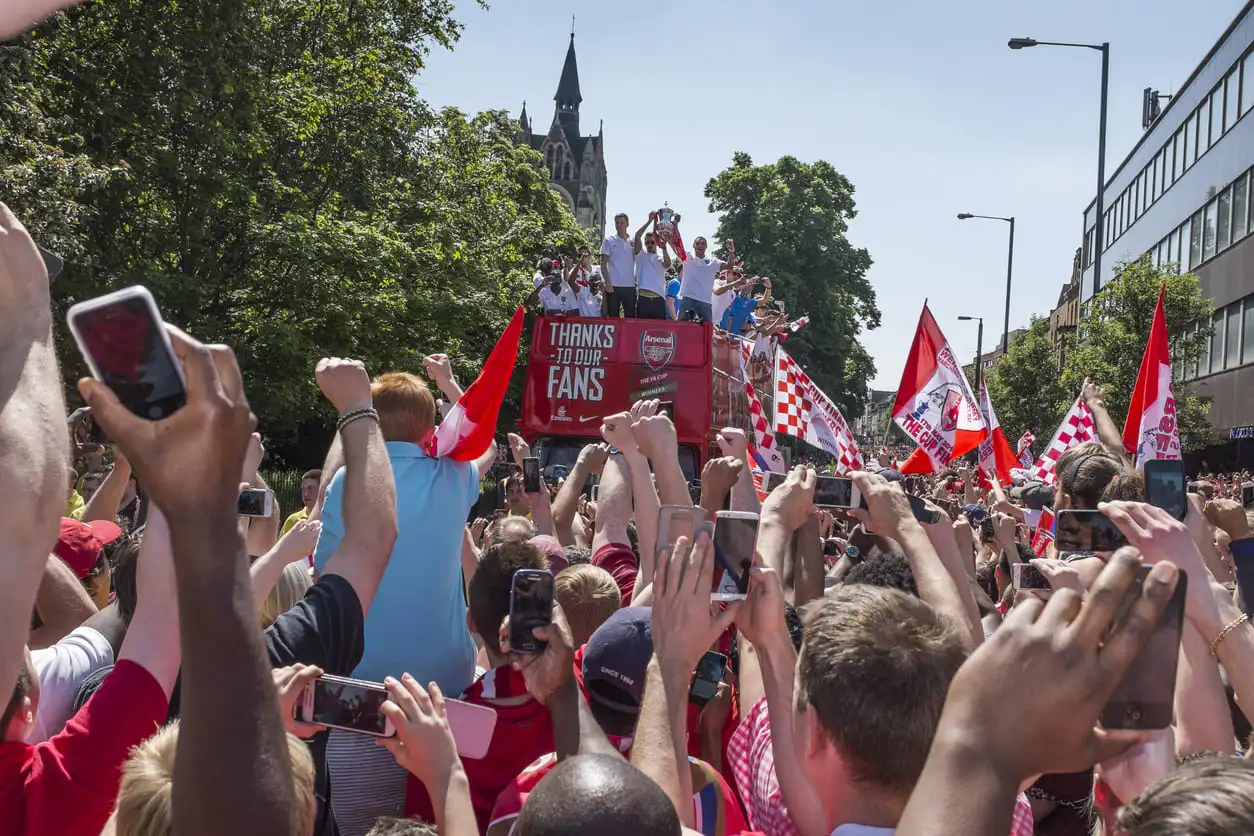
The Premier League has long been a central part of English culture, but its global influence is accelerating, in part thanks to social media giving international fans new ways to engage in the football conversation.
During the 2025-29 cycle, the league’s domestic TV rights are valued at £1.67bn per year, a modest rise from previous seasons. However, its international rights have surged to £2.17bn—a tenfold increase since 2007.
Social platforms play a crucial role in driving this growth for sports clubs. People around the world can tap into interviews, creator commentary, memes, match analysis and near-instant highlight clips whenever they want. This consistent exposure across YouTube, TikTok and Instagram reinforces the league's cultural impact and creates a global fan community.
The geographic spread of the Premier League’s 79M Instagram followers shows how global the league has become.
Here are the top locations of the Premier League’s Instagram followers:
Due to this global audience, the creators contributing to conversations around teams and the league are equally diverse.
Using Kolsquare data, we analysed the types of accounts generating the most buzz around Premier League teams. We’ve reviewed accounts tagging the Premier League during the 2025-2026 season, specifically between August 15 and November 21, 2025.
Here is a breakdown of the five Premier League clubs activating the most Instagram accounts:
Among clubs outside the top five, Crystal Palace and Aston Villa have a high share of mega-influencers at 10.2%. Nottingham Forest stands out with the highest macro-creator percentage of the top ten teams at 24.5%.
Many teams activated fewer creators. For example, West Ham was tagged by 323 accounts, and Fulham was tagged by only 173.
The highest-performing teams, as measured by EMV generated via tagged content, are supported by a strong base of micro-influencers. These are often niche creators who create content solely about their favourite team or in the football niche. Their fans are engaged and seeking conversations about football.
Often, brands struggle to compare the impact of traditional marketing campaigns with influencer activity. Simple metrics, such as the number of creators activated, don’t translate easily across channels.
Earned media value (EMV) helps close that gap. EMV estimates how much the buzz generated by influencer content (likes, comments, shares) would have cost if purchased through paid advertising. It gives brands a clearer way to benchmark awareness campaigns and compare performance across channels.
Here are the top five teams in the Premier League ranked by EMV:
Overall, the data shows that both the number of creators and the resonance of their content shape a team’s online performance. To measure that connection, we need to look at the number of engagements.
The engagement rate reveals what percentage of an influencer’s audience interacted with a post. It’s a better indicator of audience connection and community than follower counts or views.
While TikTok is typically the platform with the highest engagement rates, content tagging the Premier League on Instagram generated higher engagement rates than TikTok.
Let’s compare engagements on TikTok and Instagram for the top ten Premier League teams, ranked by EMV:
TikTok: 2.36% (8.73M)
Instagram: 10.18% (50.23M)
TikTok: 1.82% (6.32M)
Instagram: 6.17% (49.01M)
TikTok: 2.86% (3.76M)
Instagram: 7.96% (36.3M)
TikTok: 3.4% (34.49M)
Instagram: 4.64% (34.77M)
TikTok: 1.64% (1.81M)
Instagram: 4.07% (26.48M)
TikTok: 1.42% (2.36M)
Instagram: 3.48% (16.28M)
TikTok: 0.72% (1.15M)
Instagram: 6.68% (7.44M)
TikTok: 1.01% (385.38K)
Instagram: 2.8% (5.54M)
TikTok: 1.06% (1.44M)
Instagram: 5.36% (5.44M)
TikTok: 1.35% (259.7K)
Instagram: 3.09% (3.18M)
Manchester United leads on Instagram with a striking 10% engagement rate. That’s three times higher than the top on TikTok—Chelsea with a 3.34% engagement rate.
Chelsea has the league’s youngest team, with an average age of 24. It’s likely that this drives the higher engagement rate on TikTok, which has a younger customer base.
Chelsea also activates celebrity influencers. A video by British rapper Tion Wayne (@tionwayne9, 1.3M followers, TikTok) shows a visit to Stamford Bridge. It gained 234K likes, connecting with his young followers, who are mostly (56%) aged between 18 and 24.
While celebrity influencers like Wayne drive strong engagement, data consistently shows that micro and mid-tier influencers drive the strongest engagements. Why? Because they are better able to connect with their smaller communities.
Micro-creators like Shauyne (@shaunye_, 23.4K followers, Instagram) can have a considerable impact. The influencer posted a humorous Reel featuring a mock proposal interrupted when he spotted his partner’s Liverpool-themed phone background, aligning with fan sentiment.
The post went viral, achieving an extraordinary 976% engagement rate, making a meaningful contribution to Manchester United’s EMV.
The influencer, Shauyne, shared the post during the week of the team’s 2-1 win against Liverpool, arguably United’s biggest rivals, on 19 October 2025. The last-gasp win over the title holders inspired fans, resulting in a huge 20% engagement rate during the week beginning 13 October.
These emotional spikes of wins, losses and jaw-dropping moments consistently outperform regular posting cycles because they tap into shared fan sentiment for supporters and neutrals.
Fans follow these moments from around the world. The Premier League includes players from 127 countries, boosting interest from their home nations.
A good example is West Ham. With 8% of its audience based in Brazil, it’s no surprise that one of the creators generating the most buzz for the club also comes from there. São Paulo–based Victor Lo (@victorlo_, 2.71M Instagram followers) drove €889.86K in EMV for West Ham. One of his most popular posts featured the shirt of Brazilian midfielder Paquetá, one of West Ham’s top players. It’s a strong example of how international creators help sustain and expand the league’s global visibility.
Long-form content can explore these key moments with even more depth. On YouTube, deeper tactical discussions, storytelling, and analysis thrive with channels like FourFourTwo (@FourFourTwo, 632K, YouTube) and The Adam Clery Football Channel (@ACFC, 180K, YouTube).
Longer formats provide creators with space to develop storylines, build brand affinity, and nurture deeper audience relationships, which is essential when seeking to expand global influence.
There are many creators amplifying Premier League narratives. And there’s a huge variety in the styles of content they share.
Let's look at the top performers in terms of EMV.
Official football accounts, such as those for the Champions League, the Europa League, and the England National team, generate significant noise around the Premier League.
Here’s how much buzz official accounts made the top ten teams by EMV:
The Premier League is nothing without its fans. Whether they’re professional creators or casual posters, the content they share genuinely shapes community sentiment and drives real impact.
Hamid Sahari (@hamidsahari, 7.1M followers, Instagram) is an independent cartoonist from Austria. He is known for humorous football skits featuring players and managers. By jumping on trending news and conversations, he maintains an impressive 7.5% engagement rate.
Content tagging Premier League teams sits just below that at 4.95%, exceptional for a mega influencer, resulting in €12.46M in EMV. Hamid Sahari has a global follower base—almost one in five (18%) are Iranian, 9% are Indonesian, and 5% are Italian.
It’s easy to assume that bigger accounts drive all the engagement. In reality, nano- and micro-influencers are responsible for a high amount of EMV. And they come from all over the world.
SAMOHT (@by.svmoht, 4.9K followers, Instagram) is a standout French nano-influencer, with 63% of his audience based in France. He has generated €76K in EMV for Premier League teams during the specified period. His reel showing a visit to the Arsenal stadium brought in 5K engagements, resulting in a 114.42% engagement rate, worth €11K in EMV.
German micro-influencer, Livia Winter (@livia.wnr, 40.8K followers, Instagram) generated an impressive €4.61M in EMV from Premier League-related content. Although she primarily follows the Bundesliga, she also mentions Premier League clubs.
American influencer Travis Parker (@travisparkerhair, 74.3K followers, Instagram) is a hairstylist and creator whose football content comes entirely out of left field. In one post reviewing extreme hairstyles by Bohdan Vasylkov, he tagged Chelsea FC and Liverpool FC, generating a remarkable €749K in EMV. The vast majority (79%) of his followers live in the U.S.
Blud UG (@Bloodoffical0, 1.7M followers, TikTok) has generated €6.62M in EMV. The content features a young child wearing a fake beard, often recreating iconic football moments. His posts typically lean on humour, quick reactions, and easily shareable formats, which helps them travel fast across football fan communities. Half (50%) of the account's followers live in Uganda.
Dandy Purwadinata (@dandypurwadinata, 430.3K followers, TikTok) creates humorous football content. He generated €1.17M in EMV since August. Most of his audience (88%) lives in Indonesia.
Here are the three football stars who generated the most EMV:
The following football channels offer professional-tier content on the go:
Additionally, presenters like Emma Jones (@eljonesuk, 439K followers, Instagram) and Jolie Sharpe (@joliesharpe, 162K followers, Instagram) are also significant drivers of online conversation. They share professional interviews and are popular in the football space.
Brands and agencies have an excellent opportunity to create buzz around key Premier League moments.
Here’s how to run effective campaigns that drive EMV for your brand:
Creator activity across tiers and platforms shapes Premier League conversations and drives EMV. To act on these insights, brands require reliable and up-to-date data.
A platform like Kolsquare makes it simple to find the right creators, track EMV, monitor trends, and benchmark performance. It streamlines planning, activation, and reporting, allowing brands and agencies to focus on what works and measure impact with clarity.
Kolsquare is Europe’s leading Influencer Marketing platform, offering a data-driven solution that empowers brands to scale their KOL (Key Opinion Leader) marketing strategies through authentic partnerships with top creators.
Kolsquare’s advanced technology helps marketing professionals seamlessly identify the best content creators by filtering their content and audience, while also enabling them to build, manage, and optimize campaigns from start to finish. This includes measuring results and benchmarking performance against competitors.
With a thriving global community of influencer marketing experts, Kolsquare serves hundreds of customers—including Coca-Cola, Netflix, Sony Music, Publicis, Sézane, Sephora, Lush, and Hermès—by leveraging the latest Big Data, AI, and Machine Learning technologies. Our platform taps into an extensive network of KOLs with more than 5,000 followers across 180 countries on Instagram, TikTok, X (Twitter), Facebook, YouTube, and Snapchat.
As a Certified B Corporation, Kolsquare leads the way in promoting Responsible Influence, championing transparency, ethical practices, and meaningful collaborations that inspire positive change.
Since October 2024, Kolsquare has become part of the Team.Blue group, one of the largest private tech companies in Europe, and a leading digital enabler for businesses and entrepreneurs across Europe. Team.Blue brings together over 60 successful brands in web hosting, domains, e-commerce, online compliance, lead generation, application solutions, and social media.
Every month we gather the top data, trends, and analysis on the creator economy. Only what matters. Straight to your inbox
L’essentiel, directement dans votre boîte mail.
.webp)

%20(1)%20(1).png)
.webp)


.webp)