The State of Influencer Marketing in Europe 2025
The industry’s benchmark barometer.
- Key trends shaping 2025-2026
- Benchmarks for brands & agencies
- Platform and audience insights



Kolsquare’s State of Influencer Marketing in Europe 2025 is the result of a quantitative study conducted with NewtonX among 613 qualified influencer marketing decision-makers across 12 European countries. All respondents have at least two years of experience and direct responsibility for their company’s influencer strategy, budget or creator selection.
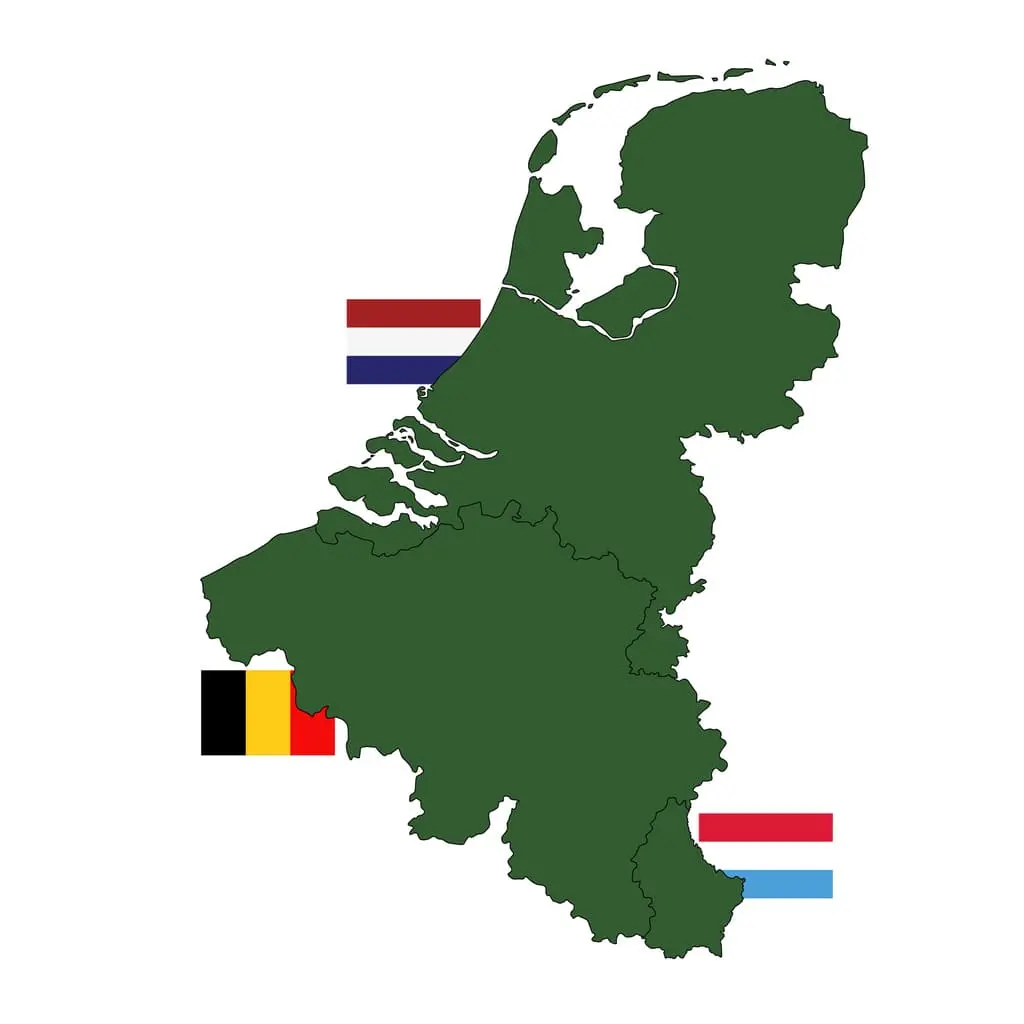
Within this European landscape, the Benelux region stands out not because of its size or budget weight, but because of its very distinctive mindset. Belgian, Dutch and Luxembourgish marketers emerge as what the study describes as “the pragmatic builders”—professionals who care less about flashy one-off campaigns and more about creating structured, scalable and measurable influencer marketing programmes. They expect steady budget growth, but they prioritise efficiency. They embrace UGC, but only when it demonstrably supports performance. They favour micro-influencers, but only when audience data confirms real alignment. And across every stage of an influencer campaign, they lean heavily on compliance, transparency and brand safety as non-negotiable foundations for long-term value.
The Benelux sample is smaller than the core European markets in the study, so the findings should be read as directional rather than exhaustive. Still, the patterns that emerge from this data are remarkably consistent. They reveal a region that is quietly advanced in how it structures influence, measures performance and governs creative partnerships.
Across Europe, influencers have become a central pillar of marketing programmes, and budgets reflect this evolution. The median annual investment now sits around €175,000, and most brands anticipate increases in 2026. Benelux follows this continental direction, but with its own distinct approach: growth is expected, but it is anchored in discipline.
Rather than pushing for dramatic jumps in spending, Benelux marketers focus on building systems that allow them to do more with what they already invest. Snapshot findings show that local teams anticipate moderate budget increases, and they direct their attention towards formats that can be reused, tested, measured and scaled—such as UGC, ambassador programmes and branded events.
This is not a conservative posture; it is a structured one. Benelux teams experiment confidently with new creative formats, but they quickly evaluate whether those tests deliver the kind of performance required to justify deeper investment. In a sense, growth in Benelux is not measured by the size of the budget, but by the sophistication with which that budget is deployed.
Like most European markets, Benelux brands rely heavily on Instagram and TikTok. These two platforms dominate the influencer landscape and serve as the natural starting point for most campaigns. YouTube and Facebook offer additional reach, while LinkedIn plays a visible role in the region’s strong B2B, tech and SaaS ecosystem.
Where the region becomes particularly interesting is in how these channels are used. While sponsored posts remain a key building block of top-of-funnel activity, Benelux strategies increasingly go beyond the classic “brief–creation–post” setup.
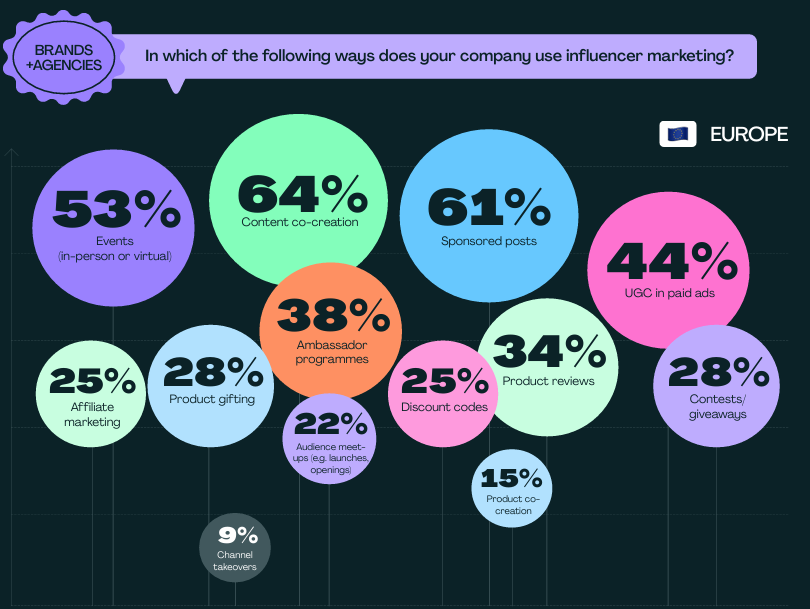
UGC activations, for example, have gained meaningful traction. This reflects a broader European trend, where almost half of marketers now repurpose creator-generated content in paid ads. Benelux teams are strongly aligned with this movement, not because UGC is fashionable, but because it gives them content they can amplify, benchmark and test at scale.
Affiliate programmes are also on the radar—not yet dominant, but far from experimental. Around a quarter of Benelux respondents say they use influencer-led affiliation, with interest growing as teams seek formats that link creative work more directly to business results.
What truly stands out in the data, however, is the strength of events and ambassador programmes in the region. Benelux marketers appear particularly comfortable working with creators through richer, more experiential initiatives, whether in-person or digital. These approaches provide depth and continuity: they create stronger ties between brands and creators, and they generate content that can be used beyond a single moment.
Altogether, the data points to a region where influencer marketing is not confined to social media posts. It is becoming an ecosystem of touchpoints that supports storytelling, brand interactions and performance objectives in parallel.
If there is one area where Benelux stands out clearly, it is measurement. The region uses KPIs in a structured way that mirrors performance marketing logic.
At the top of the funnel, the primary objective is reach. Benelux marketers tend to judge awareness campaigns by the number of people exposed to the message, with views providing an additional layer of validation. Engagement rate is monitored, but it plays a secondary role at this early stage.
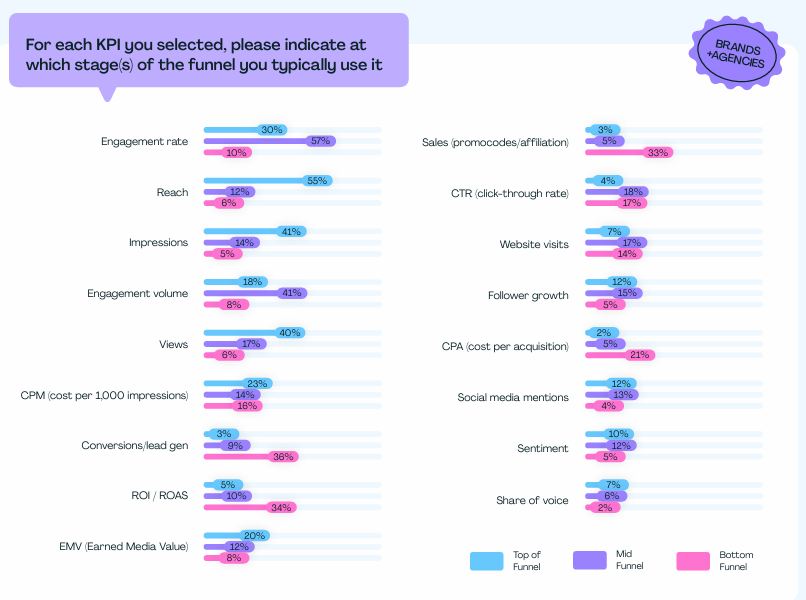
As campaigns move into consideration, the picture becomes more nuanced. Engagement rate becomes the central metric, supported by engagement volume, CTR and website visits. Benelux teams want to understand whether content is generating meaningful reactions—and whether those reactions reflect genuine interest rather than superficial interaction.
At the bottom of the funnel, performance takes over. ROI or ROAS is the top KPI in the region, followed closely by conversions and CPA. Direct sales tracking is used but is not the sole indicator; Benelux teams prefer to blend revenue-centred metrics with broader cost and efficiency signals. This balanced perspective allows them to compare influencer activity with other digital channels without relying exclusively on discount codes or ecommerce spikes.
Together, these practices form a well-defined measurement ecosystem that supports strategic clarity, internal communication and budget justification.
The way Benelux teams choose creators mirrors their measurement maturity. Casting decisions are driven by audience, not vanity metrics. According to the study, the top criteria in the region include audience demographics, content style, genuine brand affinity, engagement rate and audience interests—almost perfectly aligned with the Nordics, another highly structured region.
Follower count does not feature among the core criteria. This reflects a market that sees creators not as media personalities to sponsor, but as community leaders whose value lies in who listens to them.
This approach naturally elevates micro-influencers. Across Europe, 86% of marketers already work with micro-creators, and Benelux reflects this trend with particular consistency. Micro-profiles offer more precise targeting, more authentic storytelling and more manageable costs—advantages that align perfectly with Benelux expectations around accountability and performance.
In this context, access to reliable audience data becomes essential. Teams need tools that allow them to validate demographics, interests and audience integrity. When these foundations are solid, creator partnerships can scale more easily—and more predictably.
Ethics and responsibility are not treated as administrative obligations in Benelux; they are considered fundamental to campaign stability and long-term performance.
Across Europe, compliance with advertising regulations is the number one ethical requirement cited by marketers, and the Benelux snapshot mirrors this priority closely. Teams place significant importance on correct disclosure, respect for local rules and avoiding sensitive categories.
This has practical consequences. Content that is compliant from the outset is safer to amplify in paid media, less likely to trigger platform restrictions and more likely to maintain audience trust. In a region that relies heavily on performance metrics and transparency, ethics are not a barrier—they are an investment.
More than a third of European marketers already use a dedicated influencer marketing platform, primarily for discovery, audience vetting, compliance and reporting. Benelux adoption sits slightly below this average, but the appetite for structure, clarity and accountability is clearly there.
For a region defined by data-driven thinking, technology becomes a natural multiplier. A platform like Kolsquare can support Benelux marketers in several critical areas: identifying creators with the right audience profile, validating audience integrity and brand fit, managing collaborations efficiently and consolidating KPIs across the funnel in a way that makes internal reporting seamless.
As programmes grow to include more markets, more creators and more formats, technology becomes essential—not to replace strategic thinking, but to give it the structure it needs to scale.
When viewed as a whole, the study paints a compelling picture of the Benelux influencer marketing landscape. It is not a market defined by large budgets or explosive growth. Instead, it is characterised by a clear sense of purpose: growth built on structure, creativity anchored in data and performance supported by transparency.
For brands and agencies in the region, the path forward starts by formalising what is already working. Strengthening the use of funnel-specific KPIs can make strategies more comparable and easier to defend internally. Systematising audience-first casting ensures that each creator partnership reflects real alignment and relevance. Giving more structure to collaborative formats such as UGC helps teams reuse creator content more intelligently across paid and organic channels. Embedding ethical requirements upstream ensures that compliance supports—not limits—performance. And embracing dedicated tools provides the infrastructure needed to grow confidently without increasing complexity.
Ultimately, what emerges from the data is a region that is not loud, but effective. Benelux marketers are building influence with clarity, consistency and long-term thinking. Their programmes may not flood the landscape with volume, but they set a high standard for what responsible, measurable and scalable influencer marketing can achieve.
This Benelux snapshot is only a glimpse of what’s changing across Europe. The full report reveals the dynamics shaping budgets, creator selection, formats and performance in 12 countries.
You can download the full study below — and if you want to go further, our Kolsquare experts are available completely commitment-free to help you assess your current strategy and identify growth opportunities.
Kolsquare is Europe’s leading Influencer Marketing platform, offering a data-driven solution that empowers brands to scale their KOL (Key Opinion Leader) marketing strategies through authentic partnerships with top creators.
Kolsquare’s advanced technology helps marketing professionals seamlessly identify the best content creators by filtering their content and audience, while also enabling them to build, manage, and optimize campaigns from start to finish. This includes measuring results and benchmarking performance against competitors.
With a thriving global community of influencer marketing experts, Kolsquare serves hundreds of customers—including Coca-Cola, Netflix, Sony Music, Publicis, Sézane, Sephora, Lush, and Hermès—by leveraging the latest Big Data, AI, and Machine Learning technologies. Our platform taps into an extensive network of KOLs with more than 5,000 followers across 180 countries on Instagram, TikTok, Twitch, Facebook, YouTube, and Snapchat.
As a Certified B Corporation, Kolsquare leads the way in promoting Responsible Influence, championing transparency, ethical practices, and meaningful collaborations that inspire positive change.
Since October 2024, Kolsquare has become part of the Team.Blue group, one of the largest private tech companies in Europe, and a leading digital enabler for businesses and entrepreneurs across Europe. Team.Blue brings together over 60 successful brands in web hosting, domains, e-commerce, online compliance, lead generation, application solutions, and social media.
Every month we gather the top data, trends, and analysis on the creator economy. Only what matters. Straight to your inbox
L’essentiel, directement dans votre boîte mail.
.webp)




.webp)