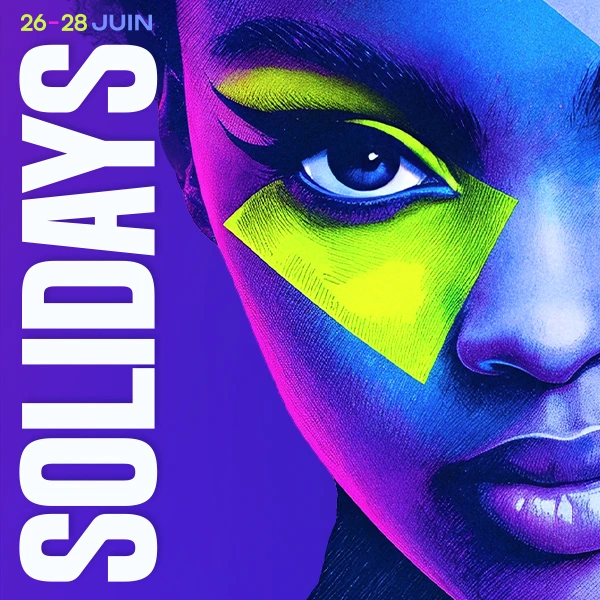
More than a music festival: Solidays turns culture into a force for solidarity
Created in 1999 by the non-profit organisation Solidarité Sida (AIDS Solidarity), Solidays is far more than a music festival. It is a large-scale fundraising and awareness platform dedicated to the fight against HIV/AIDS, in France and internationally.
Unlike organisations primarily focused on funding medical research, Solidays directs its resources toward on-the-ground programmes: supporting people living with HIV, expanding access to treatment and prevention, and helping local organisations in regions where antiretroviral drugs and even basic protection remain inaccessible.
“When you buy a ticket for Solidays, you can help women in Africa access antiretroviral treatment or sex workers in India gain access to condoms,” explains Julie Beiger, Head of Influence at Solidays.
In more than twenty years, the festival has welcomed over 4 million festivalgoers and raised more than €100 million to fund grassroots programmes around the world. But its impact goes far beyond fundraising. In France, Solidays is recognised as a public interest festival, a genuine tool for educating and mobilising young people.
For three days at the Hippodrome de Longchamp in Paris, festivalgoers dance to music by major artists that sits comfortably amongst HIV/AIDS prevention campaigns, educational exhibitions, and conferences within a vibrant village that brings together more than 100 associations.
At a time when HIV diagnoses among young people have risen significantly over the past decade, open conversations about sexual health are encouraged and thousands of condoms are distributed during the festival.
Above all, Solidays is powered by people. Some 3,000 volunteers help bring the festival to life each year. Content creators who support the event also participate on a voluntary basis, reinforcing this spirit of community.
Independent and not-for-profit, Solidays stands apart in an event landscape increasingly dominated by major entertainment groups. Its hybrid model combines music, activism and volunteer engagement within a single committed ecosystem, where culture becomes a catalyst for solidarity.
The challenge: keeping HIV/AIDS prevention at the centre of the conversation
For Julie Beiger, the stakes go far beyond promoting a summer event. Ticket sales are essential because they finance Solidarité Sida’s programmes. But it is just as important to ensure that messages about sexual health and HIV prevention continue to reach young people clearly, consistently and without stigma.
“We’re not simply promoting a line-up,” Julie explains. “We’re defending a cause. Music is the entry point, but the mission is what makes the difference.”
In a fragmented media landscape where young audiences trust digital voices more than institutional messaging, influencer marketing allows prevention messages to circulate naturally within communities that might never encounter them through traditional channels.
At the same time, rising production costs since the pandemic have increased pressure on ticket sales, the primary source of funding for Solidarité Sida. Influence therefore plays a dual role: amplifying prevention while supporting the economic model that funds field initiatives.
“Many people think HIV is no longer an issue,” Julie notes. “Yet HIV and other sexually transmitted infections among young people continue to rise significantly. That’s not trivial. It’s important to protect yourself.”
For Solidays, visibility is not simply a marketing objective. It is a public health responsibility. What is said at the festival must resonate far beyond the stages.
“What is said at Solidays is powerful,” Julie explains. “But it becomes even more powerful when it is amplified beyond the festival. That’s why we work with creators. They are media in their own right. They multiply our reach.”
The strategy: from YouTube pioneers to a family of committed creators
Solidays was one of the first French festivals to integrate influencer marketing into its strategy, as early as 2017. At the time, it was a bold move.
“We were pioneers,” Julie recalls. “It was obvious to us that creators were becoming real media channels.”
Since the first collaborations with YouTubers, relationships with creators have grown organically. Squeezie (@squeezie, 20M followers YouTube) discovered Solidays in 2018 during his very first festival experience, before returning the following year to perform on stage. HugoDécrypte (@hugodecrypteactus, 3.69M followers YouTube) regularly attends the festival, which he supports through a voluntary partnership.
“These aren’t simple collaborations,” Julie explains. “It becomes a family. We build real relationships. They are ambassadors. They amplify what happens at Solidays and extend it beyond the festival.”
The growth in reach reflects this multiplier effect. In 2017, 15 creators generated 800,000 reach. By 2019, 93 creators achieved 53 million reach.
Today, the influencer programme is more structured and strategic. In 2025, 43 creators managed directly by Julie’s team generated nearly 9 million reach and close to €1 million in earned media value (EMV). An additional 4 million reach was generated through activations led by partners.
“I used to manage more than 100 creators alone,” Julie says. “Today we are more structured. We focus on the right profiles, those who truly carry the message.”
Influencer marketing is fully integrated into the broader communication ecosystem. Creators take part in on-site press interviews, produce content for Solidays’ owned channels and contribute to cross-platform storytelling.
“It would be a shame not to connect influence to the rest of the ecosystem,” Julie adds.
Creator selection and editorial approach: values before metrics
If creators are the digital voices of Solidays’ mission, selecting the right profiles is crucial. Amplification only works if the messenger is credible. Casting therefore cannot rely solely on reach.
“We would never invite someone whose positions contradict our principles,” Julie explains. “It’s essential that the creator genuinely shares our values.”
Using Kolsquare’s data-driven search engine, the team analyses the profiles of creators requesting accreditation to verify the authenticity of their audiences and their alignment with Solidays’ values. This is especially important given the high volume of requests and limited number of available spots.
The team selects a carefully balanced mix of micro and macro creators across areas such as health, food, music, sustainability, inclusivity and diversity. Each profile is chosen not only for audience size but also for its ability to embody a specific facet of the festival’s identity.
Engagement rates and credibility scores are analysed in detail.
“Some profiles show inflated numbers,” Julie notes. “Being able to verify audience credibility in Kolsquare is essential.”
A food creator might highlight anti-food waste initiatives. A lifestyle creator might showcase the volunteer spirit. Others focus more on prevention and inclusion messages.
Each voice adds another layer to the Solidays story and extends its message across multiple communities.
The role of Kolsquare: turning conviction into measurable impact
Selecting the right creators is only the first step. Once relationships are established and content is published, measuring amplification and demonstrating impact becomes essential. For a non-profit organisation like Solidays, intuition alone is not enough. Every action must be justified.
“For us, Kolsquare is a fantastic tool,” Julie explains. “It’s a real strategic mobilisation tool.”
The platform’s value lies in its centralised reporting, which gathers all content published during the festival. This is essential during a weekend as intense as Solidays, where tracking everything in real time is impossible.
The team can therefore measure the impact of collaborations and identify which creators truly relay the festival’s messages.
“Kolsquare helps me collect all the content and measure the impact,” Julie explains. “In practical terms, it allows us to see how many people we’ve reached and what the real resonance of Solidays is.”
Julie segments campaign reports by ecosystem, artists, partners and creators to analyse each contribution and refine the strategy year after year.
“We need to justify our actions internally,” she adds. “Having clear numbers in terms of reach and EMV makes a real difference.”
Reach that drives relevance. Relevance that creates impact.
Since launching its influencer strategy, Solidays has grown from 800,000 reach in its first year to tens of millions each year across Instagram, TikTok and YouTube.
But reach is not the end goal. It is a lever. Each impression represents a person exposed to conversations about HIV prevention, solidarity and community engagement. Each piece of content extends the educational mission far beyond the three days of the festival in June.
“We see it in the comments,” Julie explains. “People don’t just ask about the artists. They ask about the associations. They ask how they can get involved. Our main objective is not to grow our own community. It is to spread the message as widely as possible.”
At a time when global health funding is under pressure, this amplification directly strengthens the resilience of the model. More visibility supports ticket sales. More tickets fund programmes. More programmes mean greater access to prevention and treatment.
Influence therefore becomes circular. And the mission continues to travel, carried by creators who act as trusted intermediaries between activism and youth culture.
By combining cultural relevance with data-driven precision, Solidays has transformed influencer marketing into a powerful engine for awareness and fundraising. Rooted in volunteer energy, long-term creator relationships and measurable impact, the strategy proves that influence can serve far more than brand visibility.
Would you like to discover how Kolsquare can help your organisation build creator campaigns that are both meaningful and measurable? Book a demo today.


%20(1).webp)


.webp)




.webp)