


The Future of Influencer Marketing: The 2026/2027 Outlook
Kolsquare's third annual study, with fieldwork by B2B International among 1,123 marketing decision-makers across France, Germany, Italy, Spain, the UK, the Nordics and Benelux. Where the budgets are going, which KPIs hold up, how far AI has spread and why ethics became a condition of partnership. Fieldwork May to June 2026.
89% of European brands are raising influencer budgets. Only 10% call their strategy fully integrated.
The channel crossed a threshold. The organisation has not
Influencer marketing spent a decade proving it worked. This year's data says that argument is over and a different one has started, about whether the businesses spending the money have built anything capable of running it.
The spending case is settled. Nearly nine in ten organisations, 89%, expect to raise their influencer marketing budget over the next 12 months, up from 75% a year ago and 54% in 2024. 85% grew the number of creators they work with over the past year and 85% expect to grow it again. 79% of brands now call influencer marketing a core growth driver or an important supporting channel, and only 3% still describe it as experimental.
The organisational case is not. Just 10% of brands describe influencer marketing as fully integrated across the marketing mix. Roughly three in ten still run it as a standalone activity. Money is arriving faster than the structure to spend it well, and that gap is the single clearest finding in this year's study.
"Investment is advancing faster than vision, because it remains hard to connect individual influencer activations to broad, cross-cutting objectives: affiliation and conversion, awareness, consideration. Until influence is built into a full-funnel logic, with objectives and measurement aligned with the rest of the marketing mix, strategic maturity will keep running behind budgets." Fanie Genovese, Head of Social Media, digital marketing agency Better&Stronger
Budgets: the direction is up, and the floor is rising
Median annual spend across the full sample is €144,000, climbing steeply with company size: €312,000 at organisations with 500 or more employees and €367,000 at those with 1,000 or more. 60% of organisations invest more than €100,000 a year and 36% more than €200,000. The share spending under €50,000 has fallen to 16%, from 24% in 2025, which is the more telling movement. The bottom of the market is emptying out.
Agencies are marginally more bullish than brands, at 90% against 89%, and plan steeper rises: 43% are eyeing increases of 20% or more, against 38% of brands.
The money is going to amplification and to relationships that last. Paid media and boosting draws the most new budget, with 62.6% investing more, followed by long-term partnerships at 59.2% and UGC at 53.2%. The fastest riser is affiliate marketing, up 27.9 points year on year to 49.4%, with in-person influencer events close behind at 48.5%.
It is also earning its line on the P&L. 28.6% of brands say influencer marketing drives more than a quarter of their marketing-driven revenue, and 68% credit it with 11% or more.
Rosters got bigger, and selection got choosier
The share of organisations working with 100 or more influencers a year has doubled since 2024, from 18.2% to 36.8%, while the share working with fewer than 50 has fallen from 65.1% to 44.1%. Roster size tracks company size closely: 8% of the smallest firms work with 100 or more creators, against 61% of the largest.
The middle tiers carry the work. Micro influencers are the mainstay at 70.9%, macro follow at 59.7%, while nano and mega or celebrity creators trail at 30.5% and 24.6%.
Selection is about fit rather than fame. Content quality and style leads the criteria at 42.1%, ahead of engagement rate at 37.8% and authenticity at 34.7%. Raw follower count ranks lower, at 31.8%, and only companies with less than two years of experience lean on it noticeably.
Ownership is shifting at the same time. 77% of brands keep influencer marketing in-house in some form, most often with agency support, which remains the single most common model at 25%. But full outsourcing has jumped to 23% from 10% a year ago, the sharpest structural move in the data.
"Influencer marketing today spans campaign creative, creator vetting, contract law, paid amplification, event production, social commerce and attribution: half-dozen specialist jobs, not one hire. Yet the standard setup is a one-and-a-half-person internal team trying to replicate an agency stack. Rising outsourcing isn't a failure of ambition; it's what mature procurement looks like." Ertan Anadol, Founder & CEO, creative influencer agency TANKE
Ethics became a condition of partnership
The conditions brands attach to creator relationships are broadening from regulatory compliance towards values. Following advertising regulations still leads at 47.5%, ahead of commitment to a corporate ethics charter at 45%, avoiding sensitive products at 42.5% and clear disclosure of sponsored posts at 41.1%.
The fastest movement is elsewhere. Standing up against bullying and discrimination has climbed from 25.1% to 34.4%, raising environmental awareness from 16.8% to 29.6%, and disclosing or avoiding filters from 14.5% to 24.4%.
New for 2026, the study tracks whether brands require a Responsible Influence certificate or formal training. Adoption is already at 28.9% across the markets where such schemes exist, rising to 41% in Benelux, 31% in Spain and 29% in France. A bar that barely existed a few years ago is becoming a condition of signature.
"Self-regulation is the most efficient, accessible and agile way to guarantee a sustainable influencer marketing sector. It protects the interests of the followers by guaranteeing ethical content, of the influencers (securing trust) and brands (protecting brand safety). Thanks to the national influencer certificates, creators can learn the rules and are guided through this process." Patrick Marck, Director, Influencer Marketing Alliance & FeWeb (Belgium)
Measurement follows the money, confidence does not
Engagement rate remains the most-relied-on KPI in Europe at 37.2%, ahead of views at 34% and sales at 32.9%, with campaign ROI close behind at 30.2%. Outcome metrics have moved up the list, which is what you would expect from a channel being asked to justify bigger budgets.
Confidence has not moved with them. Only 41% of marketers are extremely confident in their ability to measure engagement rate, the metric they use most. Confidence is highest on the easiest things to count, with views at 56% and impressions at 50.6%, and collapses on the measures that matter to brand teams: sentiment at 22.5% and earned media value at 21% head the list of KPIs marketers trust least. Certainty is strongest in Spain and the UK, and weakest in Germany.
Marketers do match metrics to objectives rather than applying one number everywhere. Reach, views and impressions dominate at the top of the funnel, engagement rate and click-through rate lead mid-funnel, and ROAS and conversions take over at the bottom.
The platform mix widened this year. Instagram held near-universal at 90.6%, but TikTok fell 12.5 points to 66.5% and lost ground in all seven markets, a genuine pullback rather than a quirk of the sample. Facebook climbed 9.2 points to 62.7%, LinkedIn pushed to 40.2% and WhatsApp tripled to 14.7% as brands started testing messaging.
"A creator's impact extends far beyond a single post or click. It shapes brand perception and drives purchases weeks or even months later, and traditional attribution models weren't built for that reality." Jakob Wigselius, CEO Scandinavia, United Influencers / ELLE Norway
AI and platforms became the infrastructure
84% of European organisations use AI or automation in influencer marketing, 39.4% extensively across multiple use cases and 44.8% for specific ones. Only 5.1% rule it out.
What they use it for is analysis, not foresight. Audience analysis and fraud detection leads at 62.1%, ahead of content analysis at 58.9%, campaign planning and briefing at 52.4% and influencer discovery at 48.8%. Predictive performance forecasting sits at 13.9%, still the frontier of the category rather than its norm.
Dedicated platform use has surged to 65% from 38.8% a year ago, the biggest single-year move in the study. Among those who still do not use one, the barrier is capacity rather than scepticism: a lack of internal resources or expertise leads at 44%, ahead of cost at 38.2%.
"Most brands are currently using AI as a digital rearview mirror rather than a GPS. Content analysis and performance tracking are low-hanging fruit; they automate what we already know. The real value lies in predictive AI, using machine learning to forecast campaign ROI, cultural relevance, and long-term audience alignment before a single contract is signed." Clo Willaerts, Steering Committee Member, Influencer Marketing Alliance
What marketers are worried about, and what they are betting on
No single challenge dominates. Influencer freedom versus brand control leads at 29.5%, with rising costs effectively level at 29.4%, platform algorithm changes at 27% and measuring campaign ROI at 26.8%. Four problems within three points of each other, which is its own finding: the channel has no single bottleneck left.
Optimism is more concentrated. Short-form video tops the opportunity list by a wide margin at 49.2%, ahead of greater use of AI and automation at 45% and always-on, long-term strategies at 39.4%. Social commerce is climbing fast, cited by 33.5% against 28% a year ago. Regulation is the clear outlier, seen as an opportunity by just 4.5%.
Seven markets, seven answers to the same question
Every market in this study faces the same gap between spend and structure. None of them answers it the same way.
United Kingdom. The most commercially minded market in Europe. 38% of UK brands call influencer marketing a core growth driver, ahead of everywhere else, and they measure it accordingly: campaign ROI at 38.3% against a European average of 30.2%, sentiment at just 9.1%. They scale by reaching outside, with 30% fully outsourcing and 44.1% running rosters of 100 or more.
France. Europe's firmest line on creator conduct. 52% of French brands will not work with creators promoting sensitive products, nine points above average and the highest reading in the study. Measurement is idiosyncratic, leaning on impressions at 37.7% and earned media value at 23.6% while all but ignoring reach at 15.2%. Activation favours the feed over the ad break, with organic campaigns at 58% against sponsored content at 42%.
Germany. The most settled operation. 40.2% describe their strategy as established, more than any other market, and 31.5% run a hybrid of in-house team plus agency. German brands treat creator content as performance media, pushing it through paid channels at 53% against 41%, and formalise the relationship with long-term contracts at 44.9% and royalty deals at 39%.
Italy. Craft first. Content quality and style tops the selection criteria at 51%, the highest of any market, and a corporate ethics charter is the leading condition placed on creators at 57%, again the highest. Italy co-creates rather than buys, at 38.2% against 28.3%, leans on micro influencers at 75% and measures softly, with sentiment at 22.9% against 15%.
Spain. Europe's fastest adopter. 73% use a dedicated influencer marketing platform, more than any other market, and 51.9% use AI extensively, also the highest. Intent matches the equipment: 92.9% expect to raise budgets, the highest in the study, though from a smaller base, with 31.6% spending above €200,000.
Nordics. Careful and conduct-led. 14.1% describe their strategy as fully integrated, the highest of the seven, yet only 20.2% call influencer marketing a core growth driver, the lowest. Nordic brands are likelier than anywhere else to ask creators to disclose or avoid filters, at 37%, and likelier than anyone to name unreliable data as a challenge, at 30%.
Benelux. The biggest budgets and the hardest numbers. 45.3% spend more than €200,000 a year and 44.5% work with 100 or more creators, both the highest in the study. Campaign ROI is the KPI of record at 44.4% against 30.2%, and the approach is unusually formal: 41% require a Responsible Influence certificate, well ahead of the 28.9% average.
The seven markets, side by side
Where does your strategy stand? The Impact Model
With B2B International, we analysed the responses of 848 brands to isolate the eight practices that actually move influencer-driven revenue. The assessment takes three minutes and returns a score out of 100, broken down into operational readiness, campaign execution and market reach.
Take the Impact Model assessment, freely available, with no download required.
Methodology
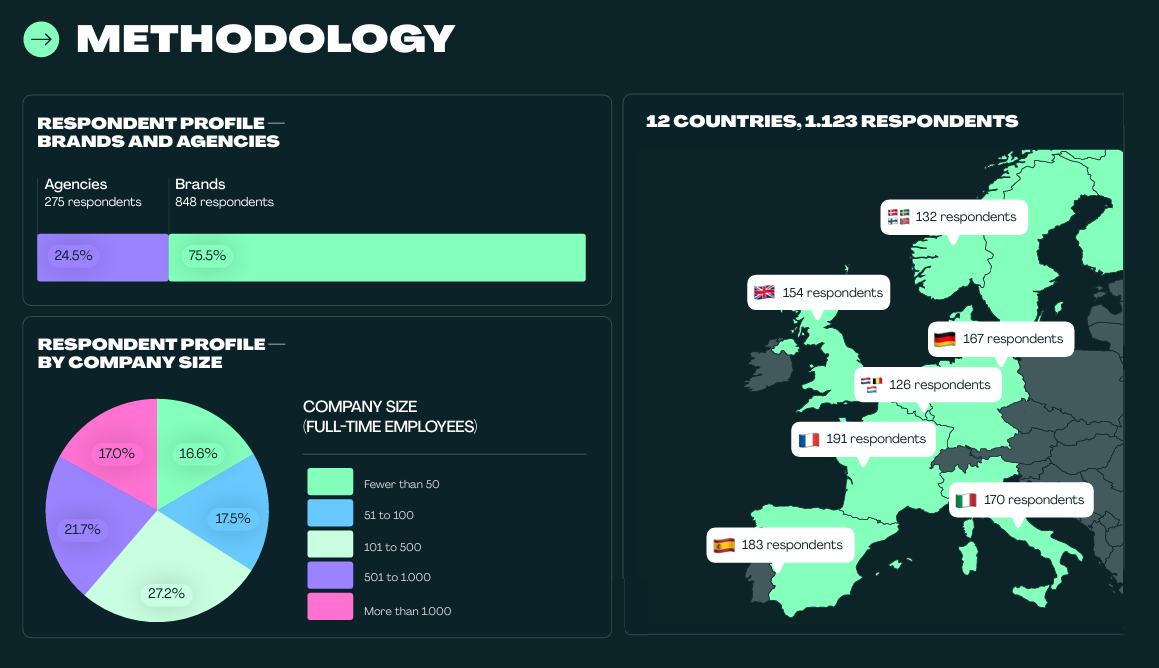
Quantitative online survey of 1,123 marketing decision-makers at brands and agencies across seven European markets: France (191), Spain (183), Italy (170), Germany (167), the United Kingdom (154), the Nordics (132) and Benelux (126). The Nordics cover Denmark, Sweden, Finland and Norway; Benelux covers the Netherlands, Belgium and Luxembourg. It is the largest sample in the study's history, up from 613 respondents in 2025 and 373 in 2024.
Respondents are senior. Roughly seven in ten hold director-level roles or above, and 96% either make the final decision on influencer strategy, budgets and partner selection or provide direct input. Two-thirds work at companies with more than 100 employees. Brands account for 848 respondents and agencies for 275.
Fieldwork was carried out by B2B International in May and June 2026. The two prior waves were run by NewtonX. Results are shown unweighted. Significance testing uses a False Discovery Rate correction at p = 0.05. Base sizes vary by question because some questions were asked only of relevant sub-groups, and year-on-year figures are reported only where the base is robust.
A note on the ethics data. The 2026 wave added a new answer option: whether brands require creators to have completed a Responsible Influence certificate or training. Respondents still name three conditions on average, so the percentages attached to existing conditions fall year on year without any drop in standards, and the leading behaviours keep their ranking. The certificate option was shown only in countries where such programmes exist. It was not offered in the UK, parts of the Nordics, or Luxembourg, so it rests on a smaller base than the rest of the table.
The numbers that matter
- 1,123 marketing decision-makers surveyed across 7 European markets, the largest sample in the study's history
- 89% expect to raise influencer marketing spend over the next 12 months, up from 75% in 2025 and 54% in 2024
- €367,000 median annual spend at companies with 1,000 or more employees; €144,000 across the full cohort
- 85% grew their creator roster over the past year; the share working with 100 or more has doubled since 2024, from 18% to 37%
- 84% use AI or automation; 65% use a dedicated platform, up from 39% a year ago
- Only 10% describe influencer marketing as fully integrated across the marketing mix
- 28.9% now require creators to hold a Responsible Influence certificate or training, where such schemes exist
- Engagement rate is the most-used KPI at 37.2%, but only 41% of marketers are extremely confident measuring it
- TikTok use fell 12.5 points to 66.5%, declining in all seven markets, while Instagram held at 90.6%
Source: Kolsquare, The Future of Influencer Marketing: The 2026/2027 Outlook, 3rd annual edition, fieldwork by B2B International, May to June 2026, 1,123 respondents across seven European markets.
Frequently asked questions
How much do companies spend on influencer marketing in 2026?
Median annual spend is €144,000 across the full cohort and climbs sharply with size: €312,000 at companies with 500 or more employees and €367,000 at those with 1,000 or more. 60% of organisations invest more than €100,000 a year and 36% more than €200,000. The share spending under €50,000 has fallen to 16% from 24% in 2025.
Will influencer marketing budgets rise in 2027?
Yes, and the intent is accelerating. 89% of European brands and agencies expect to increase spend over the next 12 months, up from 75% in 2025 and 54% in 2024. Appetite is strongest in Spain at 92.9% and the UK at 92.8%, with Benelux at 91.3%, and most restrained in the Nordics at 83.4%. Agencies plan steeper rises than brands, with 43% eyeing increases of 20% or more against 38%.
Which European market spends the most on influencer marketing?
Benelux. 45.3% of organisations there spend more than €200,000 a year, ahead of the UK at 39.6%, Germany at 38.4% and the Nordics at 36.3%, against a European average of 35.7%. Italy sits lowest at 28.3%. Spend also scales steeply with company size, from 10.8% of firms under 50 employees passing €200,000 to 61.8% of those above 1,000.
Which European market has the most mature influencer marketing?
It depends on the measure. Germany leads on established strategies at 40.2%, followed by the Nordics at 37.4% and Benelux at 36.8%. The Nordics have the highest share calling their strategy fully integrated, at 14.1% against a European average of 9.8%, and the lowest share at the very early stage, 8.1% against 15.7%. France has the largest very-early-stage group at 24.7%.
Which KPIs do marketers rely on most, and do they trust them?
Engagement rate leads at 37.2%, ahead of views at 34%, sales at 32.9%, engagement volume at 31.6% and campaign ROI at 30.2%. Trust is the weak point. Only 41% are extremely confident measuring engagement rate. Confidence is highest on views at 56% and impressions at 50.6%, and lowest on sentiment at 22.5% and earned media value at 21%.
What do brands require from creators on ethics?
Following advertising regulations leads at 47.5%, ahead of commitment to a corporate ethics charter at 45%, avoiding sensitive products at 42.5% and clear disclosure of sponsored posts at 41.1%. Values-led conditions are rising fastest: standing up against bullying is up to 34.4%, environmental awareness to 29.6% and filter disclosure to 24.4%. New for 2026, 28.9% require a Responsible Influence certificate or training.
How many influencers does a brand work with in a year?
44.1% of European organisations work with fewer than 50 creators a year, but the centre of gravity is shifting upward: 36.8% now work with 100 or more, double the 18.2% recorded in 2024. Benelux leads at 44.5%, just ahead of the UK at 44.1%, with Italy lowest at 29.5%. Roster size tracks company size, from 8% of the smallest firms to 61% of the largest.
How widely is AI used in influencer marketing, and which markets lead?
84% of European organisations use AI or automation, 39.4% extensively and 44.8% for specific use cases, with only 5.1% ruling it out. Spain is deepest at 51.9% extensive use, followed by the UK at 44.2% and Benelux at 40.5%. The dominant uses are analytical: audience analysis and fraud detection at 62.1%, content analysis at 58.9% and campaign planning at 52.4%. Predictive forecasting trails at 13.9%.
Which social network dominates influencer marketing in 2026?
Instagram, used by 90.6% of brands and agencies, more than 20 points clear of anything else. The story of the year is TikTok, down 12.5 points to 66.5% and falling across all seven markets. YouTube follows at 63.5%, Facebook has climbed 9.2 points to 62.7% and LinkedIn to 40.2%. WhatsApp tripled to 14.7% as brands test messaging channels.
How was the study conducted?
Quantitative online survey run by B2B International for Kolsquare in May and June 2026, among 1,123 marketing decision-makers at brands and agencies across seven European markets. Roughly seven in ten hold director-level roles or above and 96% decide or directly influence influencer strategy, budgets and partner selection. Results are unweighted, with significance testing using a False Discovery Rate correction at p = 0.05. The 2024 and 2025 editions were conducted by NewtonX.
Download the full study
Data, market-by-market comparison charts and commentary from industry leaders. The download includes the PDF and a markdown version of the report: load it into your LLM and ask where your own strategy stands against the market figures.

FAQ
Don't miss a thing!
Every month we gather the top data, trends, and analysis on the creator economy. Only what matters. Straight to your inbox
L’essentiel, directement dans votre boîte mail.
.webp)
