Influencer marketing can feel deceptively simple from the outside.
You see brands everywhere, creators posting constantly, products going viral, and it’s easy to assume that success comes down to scale. More creators, more content, more spend.
But when you take a step back and actually look at the data, the picture is quite different.
We used Kolsquare’s Listening feature to analyse Rimmel London alongside a group of UK beauty brands including Space NK, BPerfect, CurrentBody and others. The goal was simple: understand what is really driving performance today, and what that means for brands trying to stay competitive.
Understanding performance in isolation tells you what happened. Understanding it in context tells you what works and what your competitors are doing that you're not.
Kolsquare's Listening feature provides exactly that: a 360° overview of the creator economy, backed by real-time data that lets you analyse competitor insights to make forecasted decisions rather than reactive ones.
What we found is less about volume, and much more about how influence actually works in practice.
A legacy brand at a turning point
Rimmel London is one of the most recognisable names in British beauty. For years, its image was closely tied to celebrity endorsements and a polished, aspirational aesthetic.
But the market has shifted. Beauty is now shaped by creators, not celebrities, and by content that feels immediate rather than curated.
By the early 2020s, it was clear that Rimmel needed to adapt. Coty initiated a strategic review of the brand, and Rimmel responded with a significant repositioning. The tone changed. The creative changed. More importantly, the brand’s approach to influence changed.
The new direction leans into a more raw, everyday version of beauty. Less campaign-driven, more embedded in how people actually use and talk about products.
Leading the market without dominating volume
For this analysis of Rimmel London’s influencer marketing strategy, we selected ten leading UK-based beauty brands across different segments of the industry to benchmark against. This includes a mix of mass brands, retail-led players, DTC brands and premium names such as Space NK, BPerfect Cosmetics, CurrentBody, ICONIC London, GHD Hair, Refy Beauty, Jo Malone London and others.
Using Kolsquare’s Listening feature, we analysed their Instagram activity over a six-month period, from October through to March. This allowed us to look beyond isolated campaigns and capture a more representative view of how each brand operates over time, including seasonal peaks, content strategies and creator collaborations.
In a nutshell
Rimmel London generated £12.67M in EMV over six months not by maximising output, but by structuring its influence strategy differently:
Rimmel London generated £12.67M in EMV over six months by:
Producing 4.57K content pieces, compared to ~9K for high-volume competitors
Activating 1.31K creators, balancing scale without maximising output
Prioritising short-form video (2.14K pieces) to drive reach and visibility
Capturing ~24% share of voice across the competitive set
Appearing consistently in high-performing, multi-brand content
Timing activity around key peaks, particularly November, while limiting exposure during saturated periods
Taken together, this highlights a shift away from content volume as the primary driver of performance, towards a more deliberate balance between format, creator activity and timing.
Rimmel is not the brand producing the most content, despite working with a relatively large number of creators. Brands like Space NK and BPerfect publish roughly twice as much content, often by increasing output per creator.
At the same time, brands such as Refy Beauty achieve strong performance with fewer content pieces, pointing to a more selective, engagement-driven approach.
This is where social listening becomes useful. On the surface, those high-volume brands look dominant. But once you compare output against results, you start to see a different dynamic.
Rimmel and Refy are getting more out of each piece of content.
This also highlights a more competitive landscape than it might first appear, with some brands focusing on scale, while others prioritise engagement and creator alignment.
Format choices reflect strategic intent
Across the brands analysed, there are clear differences in how influencer marketing is being used, and those differences become most visible when you look at content formats.
When comparing brands side by side in Kolsquare’s Listening dashboards, these patterns are immediately visible in the content and format breakdown view, where output is split across short-form video, static formats and more immediate, short-lived content. This makes it easier to move beyond assumptions and see how each brand is actually distributing its efforts.
Some brands, particularly retail and DTC-led players, focus heavily on distribution. They publish frequently, rely on a large number of creators, and make strong use of more immediate, short-lived content formats. This is also reflected in the content volume and format distribution metrics, where these brands show a consistently higher output and a heavier weighting towards formats designed for frequency and direct response.
This level of output often reflects a more traditional, campaign-led approach, where scaling visibility requires scaling resources. More content typically means more creators to manage, more negotiations, and higher operational and financial investment. In that context, the question shifts from how many campaigns a brand can afford to run, to whether that level of activity is actually driving proportionate results.
Others, like Rimmel London, take a more structured approach. Its activity is less about maximising output and more about where and how content appears, with a strong emphasis on short-form video. In the same dashboard view, this shows up as a more balanced volume, but a higher concentration of content in formats that drive reach.
That distinction is not just creative. It reflects how each brand approaches influencer marketing more broadly.
Short-form video tends to drive reach and engagement. It allows content to move beyond a brand’s existing audience and plays a central role in building visibility over time. More ephemeral formats are typically more transactional. They are effective for prompting immediate action, but they rarely contribute to sustained visibility.
These differences are also reflected when looking at engagement rate and EMV side by side, where brands prioritising short-form video tend to generate more value per piece of content, even with lower overall output.
Rimmel’s format mix suggests a clear focus on cultural presence and discoverability. Other brands appear more focused on driving direct response through higher-frequency, shorter-lived content.
Both approaches are valid, but they serve different objectives and lead to different types of performance.
📢 Top 100 Beauty Brands on Instagram in Europe - H1 2026
Discover:
✔️ The most influential brands across 52 European markets
✔️ Rankings by Earned Media Value (EMV) and by segment
Looking more closely at the content itself, another pattern becomes clear.
A large portion of high-performing content is not exclusive to a single brand. Creators frequently feature multiple products within the same video, often without clear indication of whether the content is part of a paid collaboration.
This becomes particularly visible when analysing the top-performing content ranked by EMV in Kolsquare’s Listening dashboards. When you sort content this way, the posts generating the highest value are rarely single-brand placements. Instead, they tend to be routine-based videos where several products are used together, often within the same look or tutorial.
This has a direct impact on how performance should be interpreted.
First, value is often shared. A single piece of content can contribute to the visibility of several brands at once. What appears as a strong performance for one brand may, in reality, be part of a broader ecosystem where attention is distributed across multiple players. This overlap becomes even clearer when comparing brands side by side in the share of voice view, where a brand’s visibility is measured within the wider competitive set rather than in isolation.
Second, creators are not operating within exclusive relationships. Most work with several brands within the same category over a relatively short period. This is particularly visible in beauty, where routines naturally involve multiple products and brands. When exploring the top creators ranked by EMV, you can see that the same profiles repeatedly appear across different brands, often contributing value to several of them simultaneously.
At the same time, the formats that consistently perform best remain relatively stable. Get ready with me videos, tutorials and routine-based content continue to drive the majority of engagement. These patterns are easy to identify when reviewing the format breakdown and content distribution metrics, where short-form video consistently dominates in both reach and engagement.
Much of this activity sits outside tightly controlled campaign structures. It is often driven by product seeding, ongoing relationships or simply creator preference. Paid collaborations still play an important role, particularly when brands want to highlight a specific product or message, but they tend to sit alongside this broader layer of organic content rather than replacing it.
For brands, this shifts the challenge. The objective is not only to activate creators, but to ensure your product becomes part of the content that creators naturally produce and audiences already engage with.
Share of voice depends on what you measure
Rimmel accounts for roughly a quarter of total EMV across the brands analysed, placing it ahead of competitors on this metric, within a relatively competitive mid-tier group.
But one of the strengths of Kolsquare’s Listening feature is that share of voice is not limited to EMV alone. In the share of voice dashboard, you can compare brands across multiple indicators, including content volume, creator activity and engagement.
Looking at these dimensions side by side quickly changes the picture.
While Rimmel leads in EMV, it does not lead in content output. Brands like Space NK and BPerfect publish significantly more content over the same period. Switching the view from EMV to content volume shifts the ranking, bringing these high-frequency players to the top.
The same applies to creator activity. Some brands activate a larger number of creators, increasing their presence across the market, even if that does not translate into higher overall value. However, across the dataset, most brands rely on similar creator mixes dominated by micro and nano profiles, making execution and content strategy the main differentiators rather than creator size alone.
Engagement adds another layer, with certain brands achieving stronger interaction on individual pieces of content, despite a lower overall share of visibility.
Taken together, these views show that share of voice is not a fixed position, but a function of how visibility is defined.
Rimmel’s strength lies in converting activity into value. It appears consistently in content that performs well, which allows it to lead in EMV without dominating in volume. Other brands are more visible in terms of frequency or creator reach, but that visibility is more dispersed.
Timing shapes performance more than expected
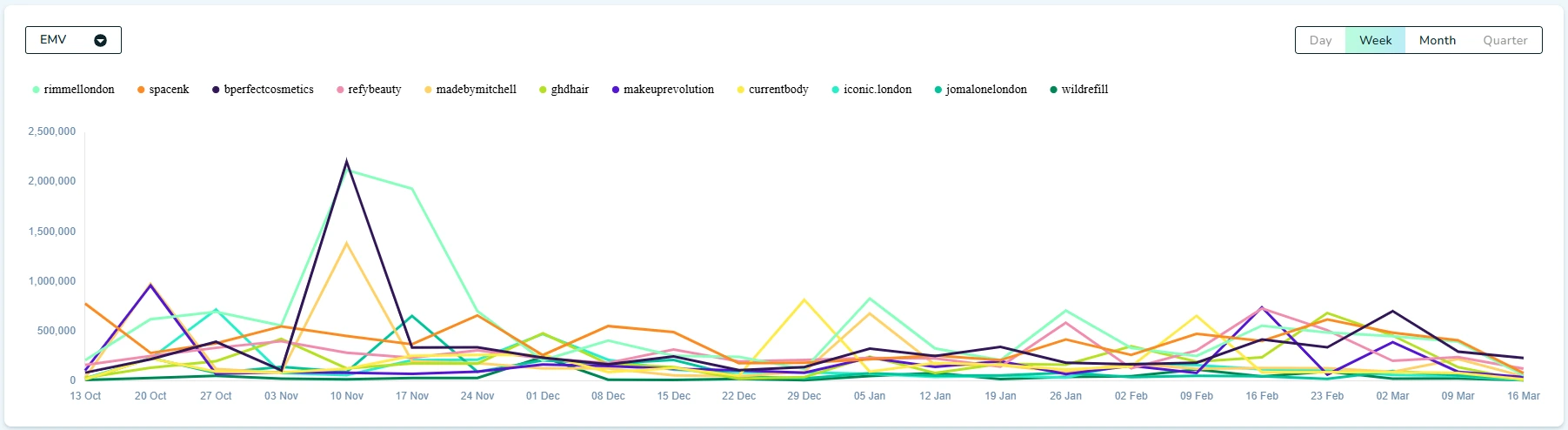
When looking at performance over time in Kolsquare’s Listening dashboards, a clear seasonal pattern emerges.
Across the six-month period analysed, activity peaks in November, driven by Black Friday and broader retail momentum. This is followed by a noticeable slowdown in December, despite it being a key shopping period. Performance then picks up again in January.
This trend is visible in the EMV over time view, where spikes and dips highlight when brands are most active and when the market becomes more competitive.
Looking more closely, there is often a small content peak in late December, reflecting a final push from some brands looking to capture last-minute gifting demand. However, this activity remains limited compared to November, suggesting that most brands reduce their influencer investment once the peak retail window has passed.
One likely explanation is saturation. In December, increased advertising pressure makes it harder for content to stand out. By contrast, January offers more space, allowing campaigns to gain visibility more easily.
For brands, this shifts how timing should be approached. Rather than aligning activity strictly with the retail calendar, it becomes just as important to understand when attention is available.
What this means for your strategy and how social listening gives you the edge
Looking across the data, a few patterns stand out.
Performance is not directly tied to volume. Brands producing the most content are not necessarily generating the most value. What matters more is how content performs, where it appears, and how it fits within the wider creator ecosystem.
Format selection plays a central role. Short-form video consistently drives visibility, while more immediate formats tend to support conversion. The balance between the two reflects a brand’s underlying objective, whether that is reach, engagement or direct response.
At the same time, influence is not contained within individual campaigns. Creators work across multiple brands, and high-performing content often includes several products at once. Much of the visibility brands benefit from sits within this shared, partially organic environment.
Taken together, this means that looking at your own activity in isolation is not enough.
This is where social listening changes the way you plan. By bringing competitor data into the picture, it becomes possible to understand how your strategy compares in terms of output, format, creator mix and overall impact.
Instead of reacting to trends, you can see how they form. Instead of focusing on isolated metrics, you can evaluate performance within the context of the market.
That shift allows brands to move beyond a single model of success and understand which approach best fits their positioning, whether that is scale, engagement, or a balance of both.
Outsmart your competition with Kolsquare
Rimmel London’s recent performance is not the result of a single tactic. It reflects a broader shift in how the brand approaches influence, from content formats to creator relationships and timing.
These are the kinds of patterns that only emerge when you analyse the market as a whole.
Kolsquare’s Listening feature is designed to support that process. It allows brands to benchmark their performance, understand competitor strategies and identify where influence is actually being generated in real time.
In a space where everyone is active, the advantage comes from knowing how the market works, and adapting accordingly.
About Kolsquare
Kolsquare is Europe’s leading Influencer Marketing platform, offering a data-driven solution that empowers brands to scale their KOL (Key Opinion Leader) marketing strategies through authentic partnerships with top creators.
Kolsquare’s advanced technology helps marketing professionals seamlessly identify the best content creators by filtering their content and audience, while also enabling them to build, manage, and optimize campaigns from start to finish. This includes measuring results and benchmarking performance against competitors.
With a thriving global community of influencer marketing experts, Kolsquare serves hundreds of customers—including Coca-Cola, Netflix, Sony Music, Publicis, Sézane, Sephora, Lush, and Hermès—by leveraging the latest Big Data, AI, and Machine Learning technologies. Our platform taps into an extensive network of KOLs with more than 5,000 followers across 180 countries on Instagram, TikTok, Twitch, Facebook, YouTube, and Snapchat.
As a Certified B Corporation, Kolsquare leads the way in promoting Responsible Influence, championing transparency, ethical practices, and meaningful collaborations that inspire positive change.
Since October 2024, Kolsquare has become part of the Team.Blue group, one of the largest private tech companies in Europe, and a leading digital enabler for businesses and entrepreneurs across Europe. Team.Blue brings together over 60 successful brands in web hosting, domains, e-commerce, online compliance, lead generation, application solutions, and social media.
Ready to elevate your marketing game with Influencer Marketing?
Our team of experts will be happy to show you our influencer platform in action and discuss your individual needs and aspirations.
What are the most popular influencer databases and tools?
Kolsquare is a popular choice for the UK and European markets. Other tools include Upfluence, Sprout Social, GRIN, HypeAuditor, and Aspire. Key features of these databases typically include influencer discovery, influencer relationship management, tracking brand posts, and monitoring performance metrics.
Here’s a rundown of the advantages of each platform and its key features:
Kolsquare: Strong for European brands, with influencer outreach, influencer relationship management, campaign tracking, and reporting.
Aspire: Good for scaling creator programs through streamlined influencer outreach and workflow automation.
Upfluence: Combines influencer discovery with ecommerce integration for brands managing creator partnerships in one place.
Sprout Social: Useful for teams that want social media management plus influencer campaign support across multiple users.
GRIN: Well-suited to ecommerce brands focused on influencer relationship management and campaign tracking.
HypeAuditor: Best for brands prioritising influencer vetting, fraud detection, and performance analytics.
The key features of these databases support complex campaigns. Often, scaling campaigns is a challenge. For example, working with multiple micro-influencers is a highly effective strategy but it’s operationally complex. An influencer marketing tool keeps you organised and improves your decision-making with reliable data. And with performance metrics, you can keep optimising campaigns and proving value to stakeholders.
How can you gain audience insights and tracking with a tool?
The Kolsquare Chrome Extension allows you to gain audience insights as you browse influencer profiles on TikTok and Instagram. This gives you valuable insights into the people who follow creators, including their age, location, and gender. For deeper insights, such as engaged audience demographics or whether a campaign has achieved its objectives, marketers can use Kolsquare’s broader analytics features.
Is there a free influencer analytics tool with a Chrome Extension?
Yes, the Kolsquare Chrome Extension gives you access to influencer analytics, such as engagement rates and audience demographics, while browsing social media accounts.
How can I get free Instagram influencer analytics?
You can use the Kolsquare Brand Influencer Insights Tool to identify influencers who are already posting about your brand. Simply input your brand’s social media handle into the space above and click “see who’s talking about you” to discover the top three influencers talking about your brand. Another key feature is the influencer tier breakdown, which tells you which types of influencers are driving conversations. You can use the tool to discover Instagram, TikTok and YouTube influencers.
How do influencer insights improve influencer marketing ROI?
Influencer insights help brands select creators whose audiences and content align with campaign goals, which boosts engagement and campaign performance. This directly impacts ROI.
How can brands find influencers talking about them?
Brands can analyse social media mentions with influencer marketing platforms such as Kolsquare to identify creators already discussing their products or services.
What is an influencer insights tool?
An influencer insights tool helps brands analyse creator mentions, identify influencers who are talking about a brand, and discover new partnership opportunities.
Why are influencer insights important?
They allow marketers to identify relevant creators, analyse influencer audiences and optimise influencer marketing campaigns.
What are influencer insights?
Influencer insights are data that help brands understand how creators impact brand visibility, audience engagement and social media conversations.
Every month we gather the top data, trends, and analysis on the creator economy. Only what matters. Straight to your inbox L’essentiel, directement dans votre boîte mail.






%20(1)%20(1).png)



.webp)





.webp)