Ready to elevate your marketing game with Influencer Marketing?
Our team of experts will be happy to show you our influencer platform in action and discuss your individual needs and aspirations.



One of the most anticipated console launches in years gave gaming talent agency Feenix Group a rare moment to build around. Over several months, it turned that moment into a five-beat creator campaign for Smyths Toys, and came away convinced that live streaming belongs at the centre of the plan, not the edges.
Smyths Toys Superstore is the UK's largest toy retailer, and gaming sits close to the heart of its business. Reaching a younger, games-first audience matters commercially, and that is exactly the crowd a Nintendo Switch 2 launch was always going to draw.
Feenix Group is the gaming talent agency that built and ran the campaign. It manages a roster of influencers and streamers, works alongside non-exclusive talent, and connects brands and agencies with youth and gaming audiences. Jake Gent, head of talent at Feenix Group, steered the Smyths campaign from the first spark of an idea through budgeting and negotiation to execution and reporting.
Few consoles arrive with as much pent-up anticipation as the Nintendo Switch 2. Its predecessor had spent years as one of the best-selling consoles in the world, so the successor landed as a genuinely global event, and the brief reflected that. Feenix was asked to amplify the console launch and then keep the momentum going through the run of game launches that followed over the next few months. The audience was the existing Nintendo faithful plus the console-curious gamers circling the release, and success was measured in visibility rather than immediate sales.
That distinction shaped every decision. A brand-new console arrives with no discount codes and no launch-day incentives to push, so the usual conversion playbook simply did not apply. Instead, the campaign was built to put the console in front of a gaming audience, show them what it could do, and nudge purchase decisions over the months that followed rather than in a single launch-day rush.
"With a one-off campaign, it's usually pretty set in stone at the beginning of what's going to be delivered, and you commit to that and you deliver it," Gent said. "Whereas with this, there was more opportunity for things to move around and be flexible, so you have to be a bit more agile and change things as the campaign's going."
Feenix organised the campaign around five beats. The console launch came first as the anchor, with four game launches following, among them Kirby and the Forgotten Land, Donkey Kong Bananza, Super Mario Party Jamboree, and Pokémon Z-A. Because everything downstream depended on that first beat landing, it carried the campaign's two biggest creators.
"We knew how big the launch was going to be, so we wanted to capitalise on that with the two biggest creators we could use, to reach their audience and gather as much awareness as possible," Gent said.
AaronTheLoco (@aarontheloco) and Spillthetea (@spillethetea) led the launch with a stream, a video, and a cosplay-blended livestream. From there the campaign shifted into a lighter, reactive gear, with short-form content responding to each game as it arrived and keeping things visible between the bigger moments.
The channel mix was chosen just as deliberately. Short-form video on TikTok, Instagram, and YouTube delivered the proven engagement of creators' existing audiences, while live streaming on Twitch and TikTok Live offered something short-form could not, holding attention over hours rather than seconds.
"With a short-form video, a viewer might only be watching for a couple of seconds before they've scrolled onto something else," Gent said. "With streaming, we can make that viewer last longer, and for a new product launch it gives them a better chance of understanding the product and visualising it in real time."
Gent's team began with a shortlist of creators spanning several gaming niches. As the beats for the campaign firmed up, the list was whittled down to five, guided by the first wave of performance data the team pulled through Kolsquare. Two questions drove the cuts: which creators could carry a Nintendo Switch 2 story credibly, and what the numbers said about how their content actually performed. Kolsquare put both in one view, tracking reach and engagement across each creator's channels so the team could see which names were delivering before committing them to the next beat.
"Kolsquare let us put content fit and performance data side by side. We could see what had actually worked before deciding who carried the next beat, instead of going on gut feel," Gent said.
Fit came down to knowing the roster. Feenix works with most of these creators exclusively, so Gent already knew who genuinely cared about which games. Three of the final creators were longtime Pokémon fans, which made casting the Pokémon Z-A beat an easy call.
"Part of it is knowing your creators and what they can authentically talk about, rather than trying to shoehorn them into a campaign just for the sake of it," Gent said. "We wanted it to come across as natural to the viewers, so they didn't have to force it."
The final five each had a clear job. AaronTheLoco anchored the console-launch stream. Spillthetea covered the console launch and Kirby, leaning on her cosplay work. iRushAlways handled short-form for Donkey Kong Bananza and Pokémon Z-A, ItsHefti took Mario Party Jamboree and a Pokémon Z-A subathon, and TheApexHound built a long-form YouTube integration around Pokémon Z-A.
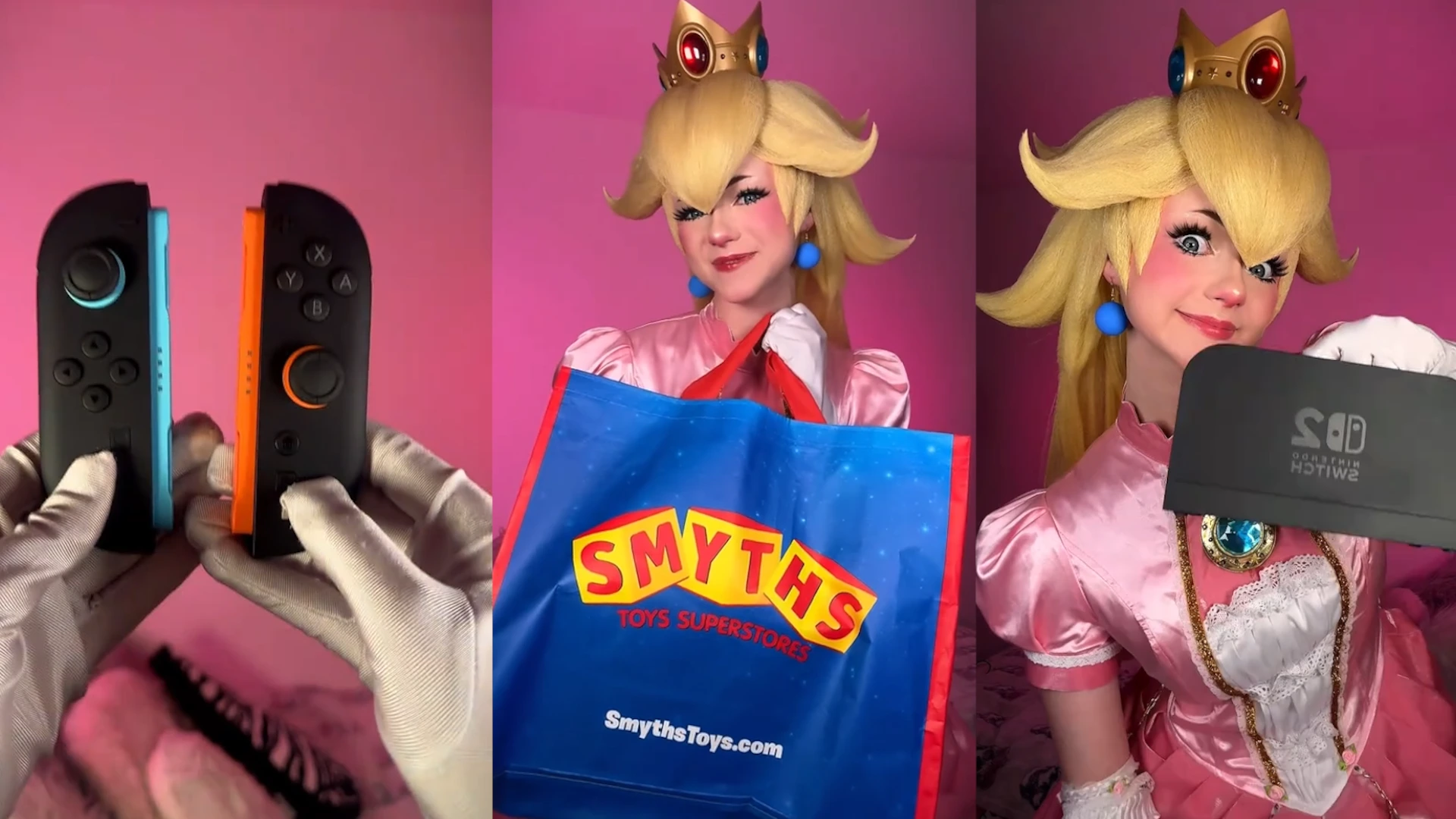
The campaign's standout creative moment grew out of that same instinct for fit. Spillthetea's Princess Peach cosplay was an idea Gent seeded himself, knowing her history with Nintendo characters, and rather than hand her a script, Feenix turned the usual process on its head.
"Rather than giving them something scripted, we turned it around and got something scripted from them," Gent said. "We gave the creator the brief, then asked her to come back with a creative concept and a rough storyboard we could get approved, so we could make sure it was going to fit with her style and audience."
Holding it all together was a single, consistent brief. The key messaging and brand guidelines stayed put from beat to beat, and only the focus changed, which gave each creator room to work in their own style while every piece still pointed back to the campaign's objectives.
A campaign this data-driven depends on knowing, before a creator is ever booked, what their content is likely to do. That is the gap a platform like Kolsquare fills, bringing together creator discovery, audience authenticity and engagement quality, and performance history across channels to validate a shortlist and forecast what each beat will deliver.
Feenix leaned on exactly that kind of read to set expectations for the livestream numbers.
"Before we booked anyone, we could look at a creator's last 30 to 90 days in Kolsquare and get a realistic read on viewership," Gent said. "The livestream numbers came in right where we expected, based on the creators we used."
At this level of investment, raw reach was never going to be enough. Audience authenticity scores and engagement quality became the deciding factors when the team weighed which creators had earned a second beat later in the run, and reach without return did not make the cut.
The one thing the campaign could not measure cleanly at the time was live streaming itself. Kolsquare has since closed that gap, becoming one of the first influencer marketing platforms to fold Twitch into cross-platform analytics. Brands and agencies can now discover Twitch creators, analyse their performance, and pull Twitch into the same reports as every other channel, so a campaign built the way this one was no longer carries a blind spot over its highest-converting channel.
Across every post, the campaign drove more than 350,000 video views and more than 11,000 engagements at a 5.4% engagement rate, a figure that stands out sharply for branded gaming content.
"This was higher than we were expecting," Gent said. "An average range is usually somewhere between 1% and 3%. We know a sponsored, branded campaign is going to be lower than a traditional piece of content from a creator, so we're really happy with how this one performed."
Live streaming supplied the depth. The streams delivered more than 1,600 hours watched and more than 9,000 unique viewers across 20-plus hours of live coverage, dominating the campaign's total watch time, while peak viewership across Instagram, TikTok, and YouTube reached 135,200.
The final beat showed how much timing can do. ItsHefti's Pokémon Z-A subathon, a live stream that runs on for as long as viewers keep engaging, folded the launch into a window when viewership and interaction were already surging. Nine hours of airtime returned 1,861 live views and 399 hours watched, the best airtime-to-viewership ratio of the whole campaign.
Beyond the numbers, the campaign made the case for its relationship-led approach. Giving creators room to shape their own concepts, casting them into games they already loved, and holding one brief across five beats produced content that read as native rather than branded, and that authenticity is what carried the engagement rate as high as it went.
Asked what he would change if he ran it again tomorrow with the same brief and the same budget, Gent would push harder on one thing: live streaming. Feenix Group has since launched an in-stream ads product that drops interactive ads into streams, either at set intervals or triggered by what a streamer says or what the chat types. Rather than a handful of sponsored streams, a campaign like this one could now serve the same ad across a couple of hundred streamers at once.
"Streaming needs to be considered as integral to the campaigns we're running now," Gent said. "It's one of the social channels we use, rather than being a separate thing."
His pitch to any brand still treating live streaming as an add-on comes down to attention and conversion rather than novelty. By his own figure, around half of Twitch viewers watch roughly eight hours of live streaming a week, the chat turns into a two-way exchange between creator and community, and links drop straight into that conversation.
"With TikTok it can be a struggle to get someone from a video to click through to an external link," Gent said. "With streams, you can put those links directly in the chat and people are able to go there. It's a much easier way to convert."
Want to measure a gaming campaign like this one, Twitch included? Book a demo with Kolsquare and see how data can power your next creator campaign.
Every month we gather the top data, trends, and analysis on the creator economy. Only what matters. Straight to your inbox
L’essentiel, directement dans votre boîte mail.
.webp)

%20(1)%20(1).png)


.webp)