Influence Responsable
Log in

English

×
![Image affichée dans la lightbox]()
Cyberbullying in Europe 2026: What data and experts reveal
From France to the U.K., NGOs and educators are warning of rising online violence among young people, as Europe moves from warnings to age limits and platform rulings.
Posted on
November 4, 2026
Teens and cyberbullying
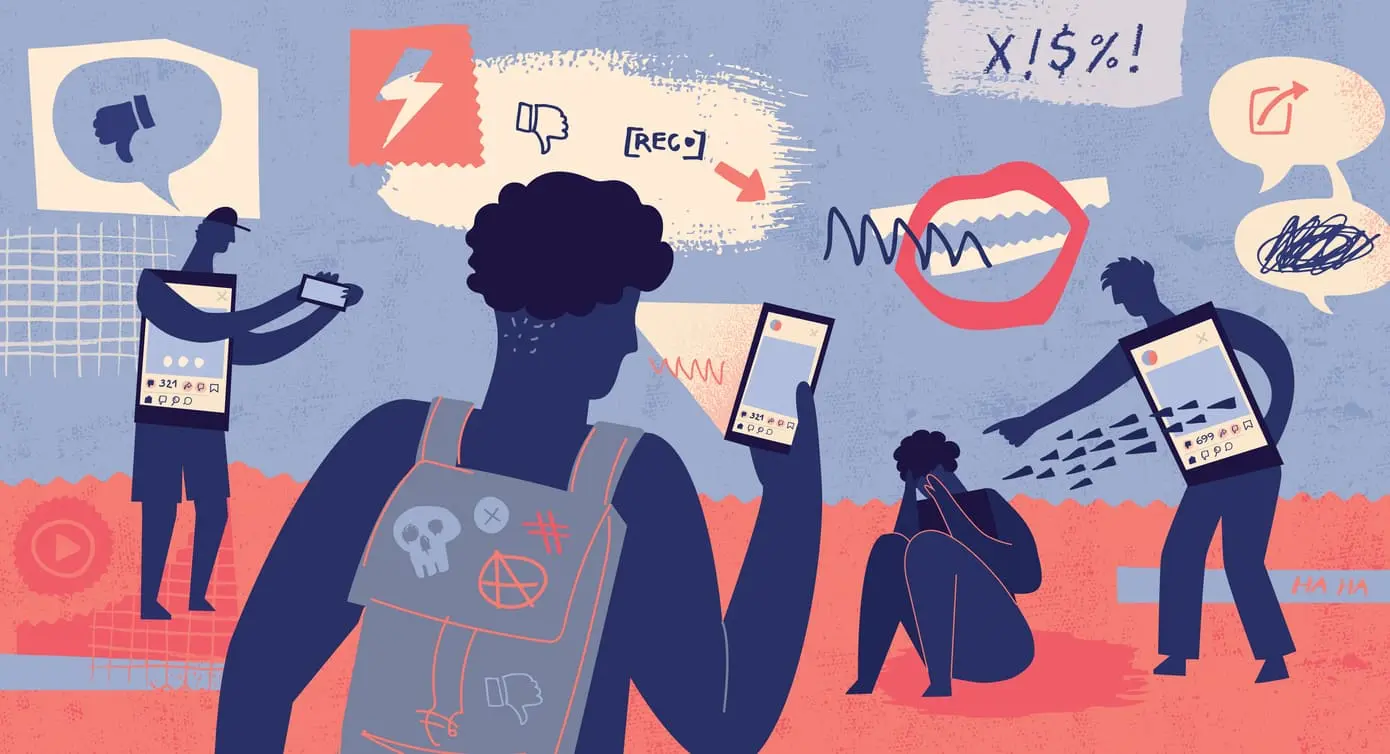
The digital playground is no fringe worry. It is the battlefield of young people’s social lives. Across Europe, anti-bullying organizations are sounding the alarm: the past few years have brought new tactics, younger victims and a heavy dose of platform-enabled aggression. This first Thursday of November is UNESCO’s International Day Against Violence and Bullying at School, Including Cyberbullying. It’s time to take stock.
Cyberbullying in Europe has grown in both reach and complexity. One in six adolescents in Europe (15%) has been cyberbullied, according to the most recent study by the World Health Organization. Rates are close for boys (15%) and girls (16%), up from 12% and 13% in 2018.
Helplines tell the same story. Cyberbullying was the top reason young people contacted the EU’s Insafe network in 2025, accounting for 15% of all contacts, according to the Better Internet for Kids 2025 recap. In the first quarter of 2026, just under 13% of the more than 17,000 contacts received by 27 helplines in 26 countries involved cyberbullying. Almost half of cases (47%) took place on social media, and 42% on messaging apps.
The consequences are serious and well documented: rising rates of mental health problems among children, self-harm, suicide and physical violence.
And the political mood has shifted. In the past 12 months, the European Parliament has called for a minimum age of 16 for social media, the European Commission has accused TikTok of breaching EU law with its addictive design, and France has passed, then lost, a ban on social media for under-15s.
Key takeaways
- Cyberbullying is still rising in Europe. One in six adolescents has experienced it, and it was the top reason young people contacted EU helplines in 2025.
- Cyberbullying is turning into cyberviolence. Harassment now includes public shaming, doxing and coordinated exclusion, well beyond one-on-one bullying.
- Europe is moving from warnings to rules. Brussels has proposed an EU-wide minimum age for social media and challenged TikTok’s design under the Digital Services Act. Experts warn that laws alone can’t keep pace with digital culture.
- Parents and educators are essential allies. Open conversation, shared time online and empathy do more to protect children than bans.
Influencers can be powerful voices for change. Campaigns like Cybersmile’s “Beyond Profiles” and research from Tilburg University show that creators who share personal stories can reduce stigma, build empathy and reach young audiences that official campaigns often miss.
From cyberbullying to cyberviolence: a bigger, more complex problem
In just a few years, online harm to children has expanded from peer-to-peer cyberbullying to the broader, darker category of cyberviolence.
The distinction matters. It reflects how digital harm has moved beyond insults and exclusion.
Cyberviolence includes exposure to violent or sexual content, online humiliation and manipulative trends. Alongside direct aggressors sits the social media feed itself, serving a steady stream of inappropriate content that young people aren’t equipped to handle.
In France, Nora Fraisse, founder of the anti-bullying association Marion la Main Tendue, said the distinction is key to understanding what children face online.
“Cyberviolence means exposure to violent, inappropriate or shocking content, something that can harm even when no one is directly targeting you,” she said. “Cyberbullying is targeted aggression. You know who is behind it, even if they hide behind a pseudonym.”
Fraisse points to what she calls a “massive lowering of the age of exposure,” with children as young as 10 regularly encountering adult content and aggressive behavior online, often without understanding what they’re seeing.
“Children are consuming content made by adults, for adults. TikTok has become their daily routine. The problem isn’t the tool itself, it’s the nature of what they see.”
In Spain, the Spanish Association for the Prevention of School Bullying (AEPAE) has watched cyberbullying among children escalate. What once happened on public social networks has moved to private group chats on WhatsApp, Discord and Telegram, where adults rarely look. EU helpline data backs this up: 42% of cyberbullying cases in early 2026 took place on messaging apps.
“We’ve moved from isolated insults to coordinated exclusion,” said Ana Mª Giménez Gualdo of the University of Málaga. “We now see image manipulation, rumors, and what we call cybergossip, where false stories spread faster than truth ever can.”
The U.K.’s Cybersmile Foundation, led by Scott Freeman, has seen the same shift in both the language young people use and the form online cruelty takes.
“What we see now is a rise in passive and indirect bullying: exclusion, ghosting, body-shaming through filters and comments,” Freeman said. “The psychological impact is no less serious than overt harassment.”
For Ivano Zoppi, secretary general of Italy’s Fondazione Carolina, the shift points to something deeper: the gamification of cruelty.
“Online aggression has become entertainment, part of the dopamine loop of likes and views. The boundaries between play and violence are blurring.”
The picture these experts paint is of harm that is often invisible and rarely simple. The question is no longer only what children do to each other online. It’s what the internet does to them.


TikTok and the new faces of online harm
When classrooms closed and playgrounds went quiet during the pandemic, TikTok became the center of youth culture. What began as an outlet for dance and comedy is now the default social hub for millions of young Europeans, where identity, belonging and validation play out in real time.
“Young people are now on TikTok much earlier than before,” Fraisse said. “It’s become part of their routine. They are no longer creators, like they used to be on YouTube; they are consumers of content, and that content can be extremely violent.”
She warned that much of what circulates on TikTok “is produced by adults for adults, but is consumed mainly by children,” which makes vigilance and media education essential.
In the U.K., 58% of young people ages 16-24 have experienced online abuse, and 87% say social media hurts their mental health, according to Cybersmile’s “Digital Wellbeing 2025” report.
“Platforms that emphasize visual content and peer validation, such as Instagram and TikTok, are particularly associated with body image issues and mental health challenges,” Freeman said.
The concern is the same in Italy. “TikTok, for the speed and virality of its content, worries us most, especially because harmful challenges and doxing are growing,” Zoppi said.
Research backs them up. A systematic review of 20 studies on TikTok and adolescent mental health found that heavy use correlates with higher levels of anxiety and depression.
In the U.K., smartphone ownership jumps from 56% of 10-year-olds to 83% of 11-year-olds, according to Ofcom’s 2026 “Children and Parents: Media Use and Attitudes” report. More than half (55%) of 8- to 14-year-olds had used TikTok in the previous four weeks. Nearly a quarter (23%) of 8- to 17-year-olds had experienced nasty or hurtful behavior in the past year, and 47% of them said it happened on social media.
The WHO also found that problematic social media use among European adolescents rose from 7% in 2018 to 11% in 2022, a jump linked to the surge in screen time after the pandemic.
For educators, the shift creates daily challenges. “Teachers are unarmed,” Fraisse said. “They have no idea what happens on these platforms. I tell them: open accounts, see what your students watch, understand their new language, you’ll also discover the dangerous challenges circulating online.”
Regulators are now taking aim at TikTok’s design. In February 2026, the European Commission preliminarily found that TikTok’s addictive features, including infinite scroll, autoplay, push notifications and its recommendation system, breach the Digital Services Act. Brussels said TikTok needs to change the basic design of its service.
In July 2026, the Commission followed up with preliminary findings that TikTok’s accounts for minors fall short of the law’s safety standards. Teens with public accounts can have their content seen by anyone, including people outside the platform, and videos posted by 16- and 17-year-olds can be pushed to strangers through the For You feed.
The European Parliament wants to go further. On Nov. 26, 2025, lawmakers voted 483-92 for an EU-wide minimum age of 16 for social media, with 13- to 16-year-olds allowed on only with parental consent. The vote was nonbinding, but it reflected a growing view that the problem lies less in single videos than in algorithms built to hold attention.
“Encouraging healthy online habits means promoting digital literacy and self-awareness, not fear or guilt. We need to empower young people with the tools to navigate these spaces safely,” Freeman said.
Europe’s policy dilemma: how to react faster than the feed
Governments across Europe are struggling to keep up with a problem that changes faster than legislation. Every country now treats cyberbullying and online violence as public health issues, yet the response remains patchy, fragmented and too often reactive.
France made school bullying, including online, a criminal offense in 2022. Spain has expanded its Plan de Convivencia Escolar to include cyberbullying prevention. Italy’s Law 70/2024 extended its 2017 cyberbullying law to all forms of bullying, requiring every school to appoint an anti-bullying lead, adopt an internal code and offer psychological support.
Neither the U.K. nor the U.S. has a specific cyberbullying offense; both rely on general harassment and communications laws. In the U.K., platforms have had to protect children from harmful content, including bullying, since 2025 or face Ofcom investigations and fines, and the government plans to ban social media for children under 16 from spring 2027. In the U.S., every state has an anti-bullying law, and the federal Take It Down Act, enforced since May 2026, forces platforms to remove intimate images posted without consent within 48 hours of a valid request. Broader federal child safety bills have yet to become law.
The newest battleground is age and access to social media. Australia became the first country to ban under-16s from social media in December 2025, and governments from the U.K. to Denmark and Spain are drawing up limits of their own. Not every attempt survives: France’s under-15 ban, passed in July 2026, was struck down a month later by the Constitutional Council, which found it disproportionate and lacking privacy safeguards for age checks.
The EU now wants one rule for all 27 member states. On Sept. 17, European Commission President Ursula von der Leyen presented the EU KIDS Act. It would bar children under 13 from social media accounts, create parent-controlled “mini accounts” for 13- to 15-year-olds, ban infinite scroll and autoplay for minors, and allow fines of up to 6% of global revenue. The European Parliament and member states still need to approve it.
Experts welcome the progress but agree that laws alone won’t stop the harm. Zoppi warned that policymakers often focus on punishment rather than prevention.
“We can’t legislate our way out of this problem. The challenge is cultural, not only legal. If we don’t change how children, parents and schools live the digital world, the laws will always arrive too late,” he said.
Fraisse sees the same pattern in France. “Each new tragedy brings a wave of emotion and a new law. But we must move from crisis management to continuous education. Prevention has to become part of daily life, not just a campaign once a year.”
Spain has introduced strict anti-bullying protocols for schools, but many still activate them only after the damage is done, according to Giménez Gualdo of the AEPAE.
“The rules exist on paper, but intervention often comes too late. By the time teachers react, the victim has already been isolated, anxious or even suicidal,” she said.
Freeman points to another gap: the lack of European cooperation. He said the Digital Services Act is a step in the right direction because it forces platforms to audit their algorithms and assess risks to minors. But transparency reports, he warned, are “only as useful as the actions that follow.”
“We still treat cyberbullying as a local or national problem, but the platforms are global. We need shared data, consistent victim support and a unified message that crosses borders,” he said.
Parents and educators: teaching digital life with empathy, not fear
If all the experts agree on one thing, it’s that protecting children online starts long before a crisis, and rarely through restriction alone. The first line of defense isn’t technology. It’s the relationships around the screen.
Across Europe, parents and educators are trying to balance vigilance and trust. They want to guide without spying and protect without isolating. That tension is sharper now that age limits are on the table: 64% of U.K. parents worry about their child being bullied online, according to Ofcom.
The experts’ advice is consistent. Work with children, not against them. Guidance should rest on the relationship, not on repression. Parents and educators can’t hand their role to filters, apps or laws. They have to stay present, empathetic and consistent.
“Families often swing between total prohibition and total permissiveness. We need a middle way: education for conscious use. That means adults entering the digital world with their children, not standing outside of it,” Zoppi said.
That means parents and teachers can no longer watch digital culture from the sidelines. They need to join children where they spend their time.
“Understanding what happens there is essential to understanding your students. Teachers should be digitally present, not to spy, but to connect,” Giménez Gualdo said.
When influence becomes empathy: creators helping young people feel less alone
A 2022 study by the Slovenian Safer Internet Centre found that 59% of secondary school students compare themselves to influencers. That gives creators a real stake in the fight against cyberbullying and cyberviolence.
“Online harm today is as much about pressure and comparison as it is about direct abuse,” Freeman said.
Influencers can bridge generations online. They translate issues like cyberbullying, body image and mental health into language young people relate to, and they can push followers to seek help or speak up. Done well, that turns a creator into a community builder.
Digital safety work is starting to recognize this. Instead of only monitoring behavior, campaigns are enlisting creators to shape positive norms online.
Research from Tilburg University in the Netherlands shows that campaigns built with creators, using authentic peer-led storylines, resonate more with children ages 10-18 and help them absorb anti-bullying messages in their daily online lives.
The Cybersmile Foundation’s “Beyond Profiles” campaign asked popular influencers to share personal stories of cyberbullying and mental health struggles. It drew more than 1 million video views with one message: “behind every profile is a person with feelings.”
“Young people need digital mentors, not digital police. When adults show curiosity instead of fear, kids are far more likely to come forward when something goes wrong,” Freeman said.
The shift is clear. Influencers are no longer seen only as part of the cyberbullying problem. They are trusted voices that can close the gap between official education programs and what young people actually experience online.
How parents and educators can support children online
On this UNESCO International Day Against Violence and Bullying at School, Including Cyberbullying, Europe’s challenge is to prepare children for technology as well as protect them from it.
- Explore together. Set up social media accounts alongside children and ask them to show you the creators, trends and challenges they follow. Curiosity builds trust.
- Talk early and often. Don’t wait for problems. Start conversations about online respect, empathy and privacy before adolescence.
- Model the behavior you expect. Children learn by imitation. Show what responsible posting, time limits and emotional control look like.
- Stay informed and visible. Educators should keep up with the platforms and slang their students use. Digital literacy helps spot risks before they escalate.
- Replace punishment with dialogue. If something goes wrong, focus on understanding and solving the problem rather than confiscating the phone. Rebuilding trust works better than fear.
Where to find help
If you or someone you know is experiencing online abuse or cyberbullying, support is available:
- France: 3018 (e-Enfance/Association Marion la Main Tendue). National helpline for digital violence and cyberbullying, free and confidential, seven days a week. 3018.fr
- France: 116 006 (France Victimes). General victim support line, including bullying and online abuse. france-victimes.fr
- United Kingdom: Childline (0800 1111). 24/7 helpline for children and young people dealing with bullying, cyberbullying and online harm. childline.org.uk
- Germany: Nummer gegen Kummer (116 111). National child helpline offering counseling on bullying, cyberbullying and family problems. nummergegenkummer.de
- Germany: Internet-Beschwerdestelle. Hotline for reporting illegal or harmful online content, including hate speech and harassment. internet-beschwerdestelle.de
- Spain: Fundación ANAR (900 202 010). Free, confidential helpline for children and teens facing bullying or online abuse. anar.org
- Spain: INCIBE Cybersecurity Helpline (017). National cybersecurity line for online threats, identity theft and cyberbullying. incibe.es
- Italy: Telefono Azzurro (1 96 96). National child protection helpline supporting victims of bullying, sexting and cyberviolence. azzurro.it
- Netherlands: De Kindertelefoon (0800 0432). Helpline for children and teens offering advice on bullying and online safety, by phone and chat. kindertelefoon.nl
- Belgium: Child Focus/Stop Cyber Hate (116 000). National helpline for missing and exploited children, including online grooming and bullying. childfocus.be
- Sweden: BRIS (020 50 50 50). Children’s rights helpline offering counseling by phone, chat or email on bullying and mental health. bris.se
- Denmark: BørneTelefonen (116 111). Free, confidential helpline for children and teens on any issue, including cyberbullying. bornetelefonen.dk
- Norway: Kors på Halsen (800 333 21). Anonymous helpline for young people facing bullying, digital harassment or loneliness. korspahalsen.no
- Finland: MLL Lasten ja Nuorten Puhelin (116 111). The Mannerheim League for Child Welfare’s national helpline, offering support on online risks and cyberbullying. mll.fi
About Kolsquare
Kolsquare is Europe’s leading Influencer Marketing platform, offering a data-driven solution that empowers brands to scale their KOL (Key Opinion Leader) marketing strategies through authentic partnerships with top creators.
Kolsquare’s advanced technology helps marketing professionals seamlessly identify the best content creators by filtering their content and audience, while also enabling them to build, manage, and optimize campaigns from start to finish. This includes measuring results and benchmarking performance against competitors.
With a thriving global community of influencer marketing experts, Kolsquare serves hundreds of customers—including Coca-Cola, Netflix, Sony Music, Publicis, Sézane, Sephora, Lush, and Hermès—by leveraging the latest Big Data, AI, and Machine Learning technologies. Our platform taps into an extensive network of KOLs with more than 5,000 followers across 180 countries on Instagram, TikTok, Twitch, Facebook, YouTube, and Snapchat.
As a Certified B Corporation, Kolsquare leads the way in promoting Responsible Influence, championing transparency, ethical practices, and meaningful collaborations that inspire positive change.
Since October 2024, Kolsquare has become part of the Team.Blue group, one of the largest private tech companies in Europe, and a leading digital enabler for businesses and entrepreneurs across Europe. Team.Blue brings together over 60 successful brands in web hosting, domains, e-commerce, online compliance, lead generation, application solutions, and social media.

Author



FAQ
No items found.




NEXT IN INFLUENCE
The must-read newsletter for influencer marketers
Every month we gather the top data, trends, and analysis on the creator economy. Only what matters. Straight to your inbox
L’essentiel, directement dans votre boîte mail.

About KolsquareFAQSLACareerContactWhistleblowingPrivacy PolicyTerms and Conditions
1177 6th Ave
New York, NY, 10036-2714
United States
New York, NY, 10036-2714
United States
