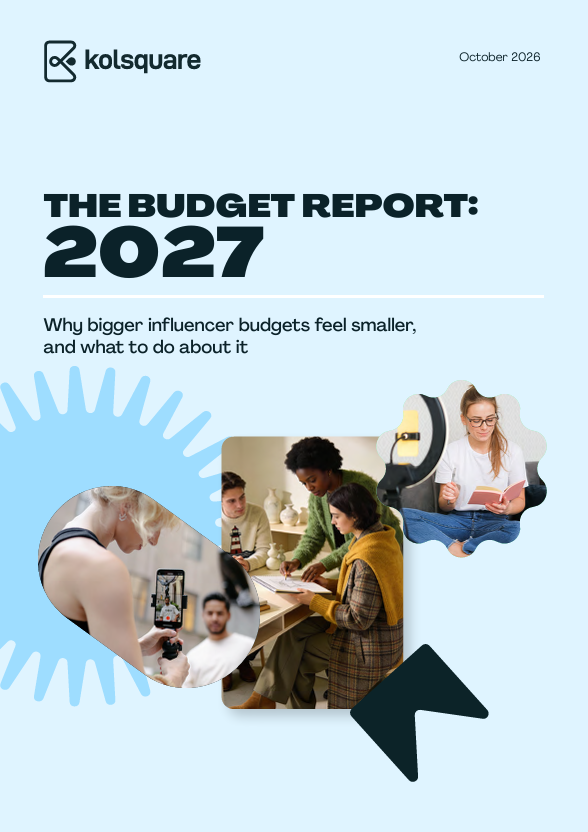
Eighty-nine percent of brands plan to raise their influencer marketing budgets next year, according to Kolsquare's The Future of Influencer Marketing survey. At the same time, creator fees, paid amplification and the cost of producing content are all climbing. The result is a budget that grows on paper and shrinks in practice.
The Budget Report 2027 looks at where that money is going and what the brands getting the most out of it are doing differently. Here are four of the levers it points to, and how teams are pulling them.
The squeeze in three numbers
13x to 4x. In just one year, the price gap between mega and micro creators collapsed from 13x to roughly 4x, according to a pricing study by Matriochka Influences in France. What does that mean? The money that once booked one celebrity no longer stretches to a dozen micro creators.
+12%. Meta's average price per ad rose 12% year over year in Q1 2026. Putting paid reach behind creator content is now table stakes, and it costs more every quarter.
10%. Nearly eight in 10 brands (79%) call influencer marketing a core or important channel. Only 10% say it's fully integrated into their marketing mix.
Put together, these numbers mean the old playbook of adding more creators to buy more reach no longer works. The report breaks down where costs are rising fastest, tier by tier, and what that means for 2027 planning.
1. Creator selection: choose on value, not follower count
In 2027, the biggest savings will come from booking smarter. The report's U.S. content value grid shows that two micro creators quoting the same fee can differ by nearly four times in earned media value (EMV). On a rate card, they look identical.
That makes selection the first place to protect a budget. The teams doing it well look past follower count to audience quality, content fit, credibility and past performance before a brief goes out.
In Kolsquare, that selection starts with data: search millions of creator profiles by audience, location and content, then check credibility, sentiment and recent performance before you build a shortlist. As one user puts it, the platform helps with "influencer research and pre-selection based on audience, content fit, and past performance."
In the full report: the complete U.S. value grid, by tier, platform and format, so you can see where any creator's content lands before you sign.
2. Forecasting: plan the outcome before the spend
When every dollar is scrutinized, "we'll see how it performs" stops being an acceptable plan. Your CFO wants an expected outcome before the money goes out.
Most teams aren't there yet. Eighty-four percent of organizations say they use AI or automation in their influencer workflows, but only 13.9% of those use it for predictive analytics, according to The Future of Influencer Marketing report. That gap is where the budget conversation is often lost.
Forecasting closes it. Kolsquare's forecasting draws on historical performance and benchmarks to estimate what a creator lineup is likely to deliver, so you can compare scenarios, adjust the mix and walk into the budget meeting with a number you can defend. Scandinavian hotel group ESS Group describes reporting and predictive analysis as key to justifying influencer spend against other channels.
In the full report: median CPM by platform and format, the benchmark that puts creator content on the same footing as paid media in your forecasts.
3. Reporting: one view, shared KPIs
Influencer results that live in a separate deck, with separate KPIs, are the easiest line item for finance to cut. Top-of-funnel work takes the biggest hit, because awareness is hard to prove when nobody agreed on how to measure it.
The fix starts before the campaign: shared KPIs for each funnel stage, agreed on with your paid, CRM and brand teams, and reported in one place. Kolsquare brings campaign results into a single dashboard, with EMV calculated using a transparent, published methodology, alongside reach, engagement, sentiment and competitor benchmarks. Live dashboards can be shared with stakeholders throughout a campaign, so nobody waits for the end-of-quarter deck.
Neutrogena and Ogilvy Spain took this approach for the launch of Collagen Bank, a single campaign across three funnel stages, tracked in one place instead of in separate reports. "Being able to track all three phases of the campaign in one place was enormously useful," says Rocio Bustamante, business director and head of influence marketing at Ogilvy Spain.
In the full report: the Neutrogena case in full, including the results it delivered, and how creator selection changed at each stage of the funnel.
4. Attribution: connect creator results to the rest of the mix
Perfect attribution is still out of reach for almost everyone. The brands making progress are connecting the data they already have, and changing how they pay for results: flat fees for awareness, commission or affiliate deals for conversion, tracked side by side.
Kolsquare's integrations bring influencer performance together with the rest of your marketing data. "With new AI integrations with Kolsquare, we will have it all: Google Analytics, our social media management tool, Meta Ads and Kolsquare," says Philip Björck, head of PR and socials at ESS Group.
In the full report: how More Nutrition built a $1.1 billion brand on a commission-only creator model, and why long-term contracts are the clearest hedge against fee inflation.
Get the full picture
The Budget Report 2027 goes further than this article. Inside, you'll find:
- The U.S. content value grid, covering nano to mega creators on Instagram, TikTok and YouTube
- Creator pricing data showing where fees are rising fastest, tier by tier
- Full case studies from L'Oréal, More Nutrition and Neutrogena
- A short list of 2027 priorities at the end of each section, ready to bring into your planning
Download The Budget Report 2027 and plan your next budget with the benchmarks
Want to see how forecasting and reporting work with your own campaigns? Talk to a Kolsquare expert.